Bridging the Gap

Why U.S. Operations Are a Strategic Differentiator for Offshore IT Services Providers

Executive Summary


Offshore IT service providers have always had an edge when it comes to cost and the ability to scale quickly. But that is not enough anymore. Today, companies want partners who can respond fast, understand how business is done in the U.S., follow local rules, and work closely with their teams without confusion. That is where having a team based in the U.S. makes a significant difference. It helps bridge the gap between strategy and execution. This paper looks at why having both offshore and U.S. teams working together is no longer just a nice to have. It is quickly becoming necessary for IT service firms that want to stay competitive and grow.

The Offshore Limitation:
Belief vs. Performance


Offshore delivery brings value, but also introduces risks:

  • Different time zones make it harder to get quick answers or solve problems fast

  • Misunderstandings happen because of language or missing context

  • Buyers worry about contracts, security, and who to call if something goes wrong

  • Teams outside the U.S. may not fully understand how things are done locally or be available when needed

According to Deloitte’s 2025 Global Business Services Survey, 61 percent of IT leaders still report communication friction as a major concern when collaborating with offshore providers. Additionally, approximately 50 percent of organizations focused on next-generation capability development maintain delivery centers in India, the U.S., and Poland, highlighting the importance of geographic balance in delivery models.

Why U.S. Operations Change the Game


A U.S. presence gives offshore IT service firms a tangible edge:

  • Shared working hours enable real-time collaboration across time zones
  • Onshore promotes and supports agile delivery, escalation, and planning
  • Buyers gain confidence through local accountability
  • Legal, contractual, and compliance conversations are simplified

In a hybrid delivery model, U.S. operations function as the engagement layer. Offshore teams continue to execute technical work efficiently, while the U.S. arm ensures clarity, alignment, and speed. This balance reduces rework, compresses timelines, and strengthens client relationships.

According to the 2025 Deloitte GBS Survey, organizations focused on next-generation IT capabilities increasingly adopt hybrid delivery models that include domestic operations. While offshore centers in India remain foundational, U.S. operations are being emphasized for proximity, legal compliance, and higher stakeholder engagement, especially in regulated or enterprise sectors.

Case in Point:
What We’ve Seen Across Multiple Hybrid Engagements


Vee Technologies has supported several clients in the insurance and financial services space, and a hybrid delivery model consistently delivers strong results. While every engagement is different, we’ve seen recurring patterns when U.S. based leads are paired with offshore engineering teams to solve system performance issues.

In one representative example, a client was facing challenges with a legacy CRM and recurring data sync issues across platforms. Our approach, refined across similar projects, included:

  • Assigning a U.S. engagement led to manage communication and planning
  • Having offshore engineers focus on resolving architectural and app level issues
  • Identifying and fixing sync delays and mobile crash points
  • Improving the accuracy and speed of report generation
  • Holding daily touchpoints to keep the work aligned and moving
  • Achieving up to a 25 percent increase in throughput within two months

This model works because it removes the friction often associated with offshore only delivery. With the U.S. team driving clarity and the offshore team executing, clients see better outcomes and smoother delivery.

Chart:
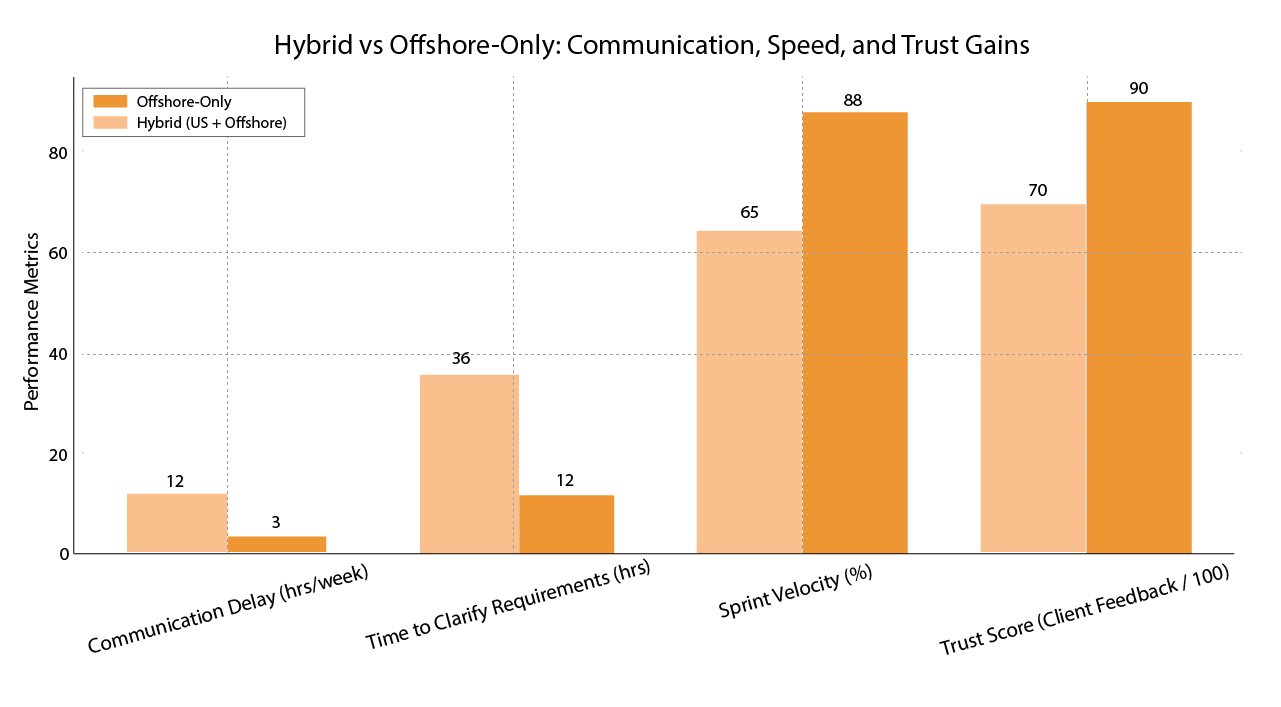
Communication and Productivity Gains with U.S. Operations


revolutionizing

Figure 1: Detailed performance comparison between offshore-only and hybrid delivery models.

Source: Internal benchmarking data from Vee Technologies hybrid delivery projects (2023–2024), supported by insights from Deloitte and McKinsey research.

Strategic Benefits Beyond Delivery


Adding U.S. operations improves more than project execution:

  • Increases eligibility for regulated or enterprise RFPs

  • Enhances win rates with procurement and legal teams

  • Builds brand trust with prospective clients and stakeholders

  • Enables face-to-face workshops, training, and strategic planning

According to McKinsey's research on smart sourcing, hybrid models will be the preferred delivery structure for 78 percent of enterprise tech leaders by 2026.

Conclusion:

Offshore IT services alone are no longer enough. Today’s enterprise clients want partners who can respond quickly, work alongside them during the day, and contribute to meaningful innovation, not just complete assigned tasks. Having teams in the United States helps close this gap. It brings a local presence, smoother communication, and the kind of trust that is hard to build from overseas. For IT service providers that want to stay competitive, this way of working is no longer optional. It is the standard.

References:

  • Deloitte. (2025). Global Business Services Survey.
    https://www.deloitte.com/us/en/services/consulting/services/shared-services-survey.html

  • McKinsey & Company. (2023). The Future of Smart Sourcing.
    https://www.mckinsey.com/business-functions/operations/our-insights/the-smart-factory-approach

  • Vee Technologies. (2024).
    https://www.veetechnologies.com/industries/it-services/it-services-insights/it-services-case-studies.htm (Data pulled from various case studies)

author

Meet the Author

Jeremy Brandon - Client Services Director

Jeremy Brandon is Client Services Director at Vee Technologies, where he partners with organizations to align business goals with IT, AEC, Manufacturing, and Product Engineering initiatives. He helps clients modernize systems, implement data-driven strategies, and design scalable solutions that support long-term growth. With a background in enterprise software and process improvement, Jeremy brings a consultative approach that bridges technical and business teams, ensuring solutions deliver measurable impact and sustainable outcomes.