We share insights, analysis and research – tailored to your unique interests – and make case studies and whitepapers to help you deepen your knowledge and impact.
Generative design isn’t just something cool to talk about anymore, it’s becoming a real driver of change in how we think about design and delivery in the AEC industry. By using AI-powered algorithms, design teams can now create thousands of design options within seconds, all based on a set of parameters, space constraints, materials, costs, and even environmental impact. This isn’t replacing designers; it’s giving them superpowers.
We’re seeing a shift away from traditional, linear design workflows and toward something a lot more dynamic, iterative, and informed. It's not about working faster for the sake of speed, it's about unlocking better, smarter decisions from the start. Phil Bernstein from Yale puts it well: “The real promise of generative design isn’t just speed. It’s about better decision-making, at scale, across disciplines” (Bernstein, 2024). That’s exactly the kind of thinking we need to move forward.
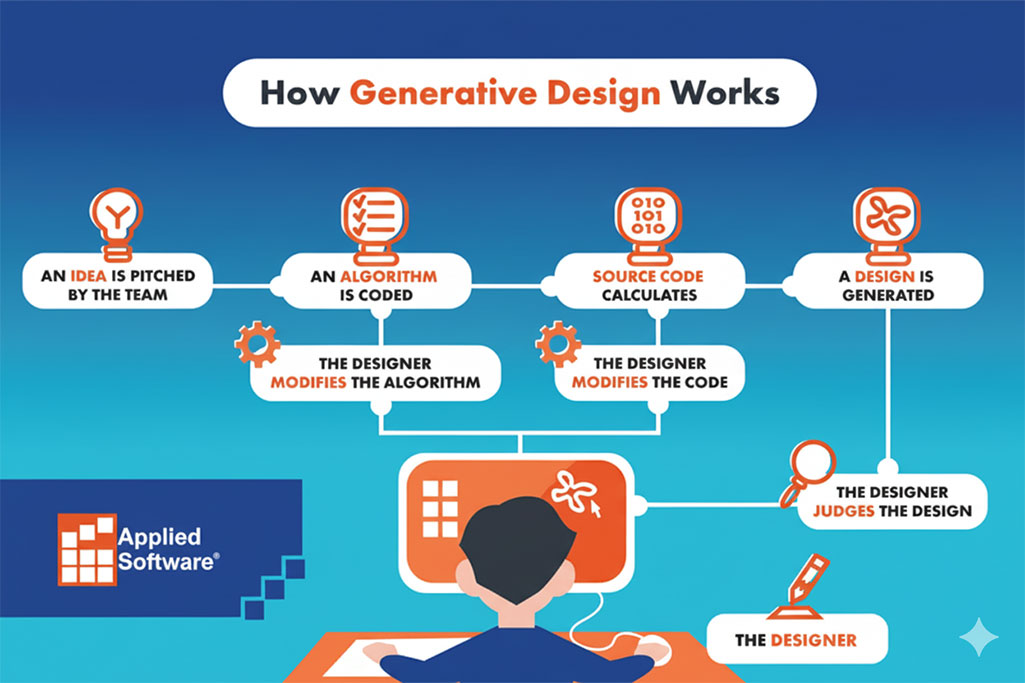
At its core, generative design is a process where designers set a goal, define the constraints (like room size, sunlight needs, or structural load), and let AI explore a range of options that fit those needs. It’s not about removing the human, it’s about expanding what’s possible.
Autodesk, one of the key players here, describes it this way: “Rather than manually drawing plans, you’re setting goals, and letting the system find creative paths to meet them” (Autodesk, 2024), and it’s starting to change how design and construction teams engage with BIM and VDC, creating a space for designers to do more high-level tasks like refining intent, guiding decision-making, and collaborating across disciplines.
This is where things really start to shift. Instead of drawing and redrawing, we’re seeing early iterations that already account for things like structural feasibility or natural light exposure. It’s like making the switch from playing checkers to playing chess, with a better view of the board.

This is not just theoretical, firms are putting this into practice in really exciting ways:
| Use Case | Impact | Example |
| Architecture | Spatial and form optimization | Gensler's flexible office design models for hybird workforce scenarios |
| Structural Engineering | Load distribution, weight saving | Arup's generative truss modeling for cost-effective bridges |
| MEP Design | Clash-free, optimized routing | Buro Happold's HVAC layout automation |
| Urban Planning | Smart zoning, sustainability | Sidewalk Lab's layout simulations for airflow, noise, and solar access |
As Carlo Ratti from MIT’s Senseable City Lab puts it, “Computers are no longer just drawing tools, they are design collaborators” (Ratti, 2024). That collaborative role is exactly where generative design shines: it helps technical and creative teams work smarter, together, and earlier in the process.
This isn’t just a designer’s toy. Generative design has real implications for operations, especially for those of us focused on delivery, efficiency, and scaling quality across multiple teams or studios. It directly impacts how quickly a project moves through design cycles, how much material is used, and how confident we are in the design before moving to the construction phase.
Statistics has shown that firms cut design timelines by as much as 50% just by leveraging these tools. They’re reducing material waste, getting stakeholder buy-in faster, and running simulations that account for seismic activity, wind patterns, and occupancy, all upfront.
One example that stands out comes from a keynote at Autodesk’s Generative Design Summit, where Zach Kron shared: “By simulating thousands of options, we reduced steel tonnage by 18 percent, a $400K cost saving on one project” (Kron, 2024). That’s the kind of operational value clients care about.
| Feature | Traditional Design | Generative Design |
| Options Explored | 2-10 | Thousands |
| Time to Concept | Weeks | Days |
| Human Effort | Manual | AI-assisted |
| Design Constraints | Linear | Multi-variable |
| Client Interactivity | Limited | High |
It’s not just about scale, it’s about freedom too. Instead of spending hours reworking options, you’re curating the best of what’s already been intelligently generated. And when clients can visually explore those options side by side, the decision-making process becomes faster, clearer, and more collaborative.
The industry is still early in the adoption curve. A few things are holding firms back:
Skill Gaps : Most teams don’t yet have people who can script or model parametrically.
Disconnected Tools: There’s still friction between generative tools and downstream production software.
Change Fatigue: Moving from tried-and-true workflows to something new always takes effort, and buy-in.
But as the AEC Disruptors podcast put it recently, “Change is hard, but so is getting left behind” (AEC Disruptors, 2025). The good news is that firms don’t have to overhaul everything at once. Pilot programs, internal R&D, and small-scale experiments are a great way to start integrating generative thinking into how your teams operate.
We’re heading toward a future where generative design works in real time, in immersive environments, and is connected to everything from permitting to procurement. The next wave will include:
Real-time design feedback in AR/VR environments
Integrated cost and material analysis at the concept stage
AI-supported code compliance baked into the design model
At Vee Technologies, our architecture and engineering support teams are already working to bring this into practice. We’re building internal capabilities around Revit and Dynamo, exploring parametric modeling, and partnering with clients to support design automation that cuts effort and boosts delivery speed. Whether it’s improving clash detection or streamlining HVAC layouts, we’re already applying this kind of thinking, and we’re just getting started.
https://www.youtube.com/watch?v=wTCoXL3iFag
https://www.autodesk.com/design-make/articles/generative-design-in-manufacturing
https://www.gensler.com/publications/design-forecast/2025?q=design%20forecast
Link Keynote
https://www.mckinsey.com
https://senseable.mit.edu
https://senseable.mit.edu/
https://open.spotify.com/show/1wE02ze4DiWP33gTdzMJdl
https://matthewlarn.medium.com/the-future-of-design-leadership-in-the-era-of-ai-e56e75f68076
Marissa Jacobson serves as the Senior Engineering Director of Client Operations and BIM Management at Vee Technologies. She has over 10 years of experience in architecture and engineering with extensive commercial, residential, and institutional project portfolios with an emphasis on design and management. Marissa fosters an environment of teamwork and ensures that strategy is clearly defined while overseeing design, quality, and technical performance. Her strong communication and client relationships skills enhance Vee Technologies process-driven management style.