 USA (English)
 France (French)
 Japan (Japanese)
 USA (English)
 France (French)
 Japan (Japanese)
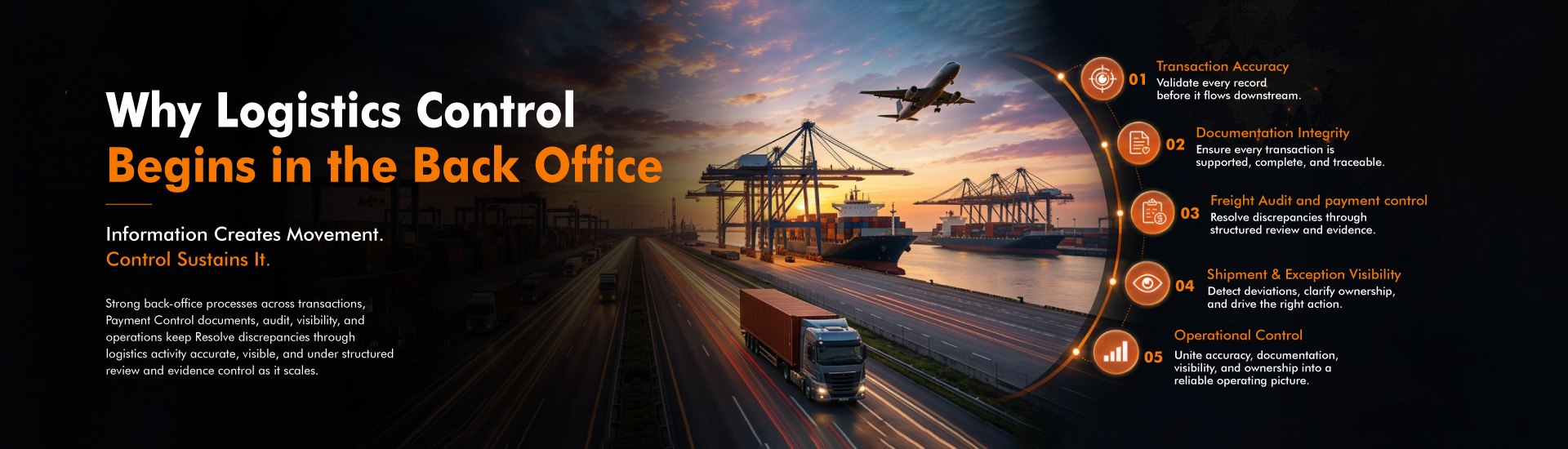
Why Logistics Control Begins in the Back Office
Why Logistics Control Begins in the Back Office
This article maps the five back-office layers — transaction accuracy, documentation integrity, freight audit and payment control, shipment and exception visibility, and operational control — that determine whether logistics activity stays under control as it scales.
Logistics Activity Is Growing. Operational Control Is Harder to Maintain.
Logistics operations are judged by movement but managed through information. As shipment volumes rise, logistics teams must coordinate dense flows of freight invoices, carrier records, status updates, exceptions, approvals, and reporting requirements. Each transaction creates another point at which accuracy can be preserved or control can begin to weaken.
The operational environment is also placing new demands on logistics capabilities. In Inbound Logistics’ 2024 survey, 62% of participating 3PL providers identified technology investment as a challenge, making it the second most frequently cited challenge after rising operational costs.
The pressure is not limited to processing speed. A freight bill may arrive without complete supporting information. A shipment update may require repeated follow-up. A documentation discrepancy may delay review. An exception may remain visible but lack clear ownership. Individually, these issues can appear routine. Across high-volume operations, they can make it harder to determine what is accurate, what requires attention, and what has been resolved.
Disciplined logistics back-office operations matter for exactly this reason. Freight bill processing, shipment tracking support, carrier documentation, exception handling, and reporting are not merely administrative activities surrounding logistics. Together, they create the operational record that allows logistics teams, customers, carriers, and internal stakeholders to work from reliable information.
When that record is incomplete or inconsistent, physical movement may continue while operational confidence declines. Teams spend more time reconciling information, tracing documents, requesting updates, and clarifying responsibility. The visible logistics network remains active, but the control layer behind it becomes increasingly fragile.
The central challenge is therefore not simply moving more transactions through the back office. It is maintaining accuracy, visibility, and accountability as operational volume and complexity increase.
Logistics activity creates movement. Back-office discipline makes that movement visible, explainable, and controllable.
The Hidden Exposure: The Logistics Control Gap
Operational control rarely disappears through one major failure. It weakens through information gaps that remain unresolved as transactions continue.
A freight invoice enters review without complete supporting records. A shipment update appears in one system but not another. An exception is identified, yet its resolution path remains uncertain. Each event widens the distance between operational activity and what the business can reliably verify or act upon.
This is the Logistics Control Gap.
Definition: The Logistics Control Gap is the difference between logistics activity and the back-office accuracy, visibility, documentation, ownership, and exception control required to manage that activity reliably at scale.
The gap widens at handoffs, particularly when freight and shipment information crosses systems, teams, or approval stages without consistent validation and traceability.
The consequences compound: a missing reference stalls an invoice, which delays a customer answer, and the original gap deepens. The transaction remains active, but controlling it requires greater effort.
Importantly, the Logistics Control Gap is not simply a data-quality issue. Control weakens when records are incomplete, disconnected, delayed, or unavailable when a decision must be made.
Closing the gap therefore requires more than faster logistics back-office processing. It requires dependable controls across transactions, documentation, freight audit and payment workflows, shipment visibility, and exception ownership.
The question is not whether logistics activity can continue. It is whether the information surrounding that activity can keep it under control.
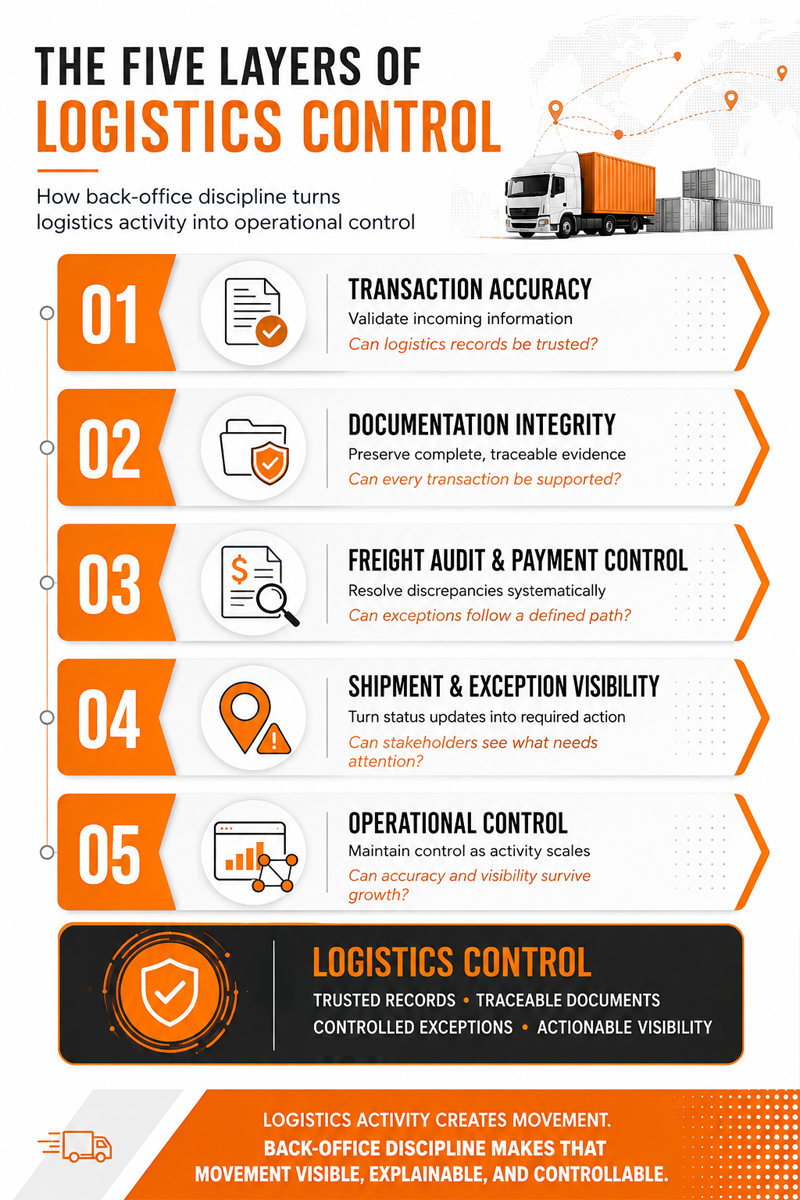
The Five Layers of Logistics Control
Closing the Logistics Control Gap requires more than correcting isolated records or accelerating individual tasks. It requires a connected control system in which each back-office process strengthens the reliability of the next. The Five Layers of Logistics Control provide a practical way to evaluate that system.
Definition: Logistics Control is the ability to maintain trustworthy records, complete documentation, dependable validation, visible shipment status, and accountable exception handling across logistics back-office workflows.
Layer 1: Transaction Accuracy
Every control decision begins with information that can be trusted. Freight invoices, shipment records, charge details, reference numbers, and supporting data must be reviewed consistently before they enter downstream workflows. Accuracy at this stage does not guarantee control, but unreliable transaction data makes control impossible.
Control question: Can logistics records be trusted?
Layer 2: Documentation Integrity
A valid transaction must also be supported by complete, accessible, and traceable documentation. Carrier records, shipment documents, invoice support, and approval evidence help teams understand what occurred, what was verified, and what remains unresolved. Documentation integrity gives operational activity an explainable history.
Control question: Can every transaction be supported and traced?
Layer 3: Freight Audit and Payment Control
Freight invoices may contain discrepancies, missing information, or conditions requiring review. A dependable freight audit and payment workflow defines how invoices are validated, how exceptions are identified, what evidence is required, who owns the next action, and when a case is ready to proceed. The aim is controlled resolution, not merely faster processing.
Control question: Can discrepancies move through a dependable review process?
Layer 4: Shipment and Exception Visibility
Status information becomes valuable when it helps stakeholders recognize where intervention is required. Shipment tracking support should therefore do more than report movement. It should help distinguish routine progress from delays, documentation gaps, communication issues, and other exceptions requiring ownership or escalation.
Control question: Can stakeholders see both status and required action?
Layer 5: Operational Control
The final layer joins the previous four. Trusted transactions, traceable documents, controlled invoice exceptions, and actionable shipment visibility create a more dependable operating picture. Logistics teams can then direct attention according to risk and priority rather than relying on repeated reconciliation and manual follow-up.
Control question: Can accuracy and visibility be maintained as activity scales?
These layers are interdependent. Accurate transactions without supporting documents remain difficult to defend. Complete documentation without exception ownership can still leave issues unresolved. Tracking without action visibility reports activity but does not strengthen control.
The framework therefore measures more than back-office completion. It evaluates whether logistics information remains trustworthy, traceable, actionable, and manageable as operational demands increase.
Freight Bill Processing Is a Control Function
A freight bill is not ready to proceed merely because the required fields are populated. Its value as an operational record depends on complete, consistent, and review-ready information.
Disciplined freight bill processing begins by establishing what must be checked before an invoice enters downstream approval or payment-support workflows. Shipment references, carrier details, charges, dates, and supporting records must be examined against defined process rules. The objective is to distinguish records that can proceed from those requiring clarification.
That distinction is the control point. Skip it, and incomplete information travels deeper into the workflow, surfacing later as follow-up across teams, systems, and documents that never needed to be involved. Build it in, and discrepancies peel off from routine transactions before they can spread.
Freight bill processing also strengthens traceability. A clear record of what was received, what was checked, what was missing, and what action followed allows later reviewers to understand the status without reconstructing the transaction from scattered correspondence.
For logistics teams, the real measure of the process is therefore not the number of invoices moved forward. It is the reliability of the decision attached to each invoice: proceed, clarify, correct, or escalate.
Freight bill processing becomes a control function when validation determines what happens next.
Freight Audit and Payment: Containing Exceptions Before They Multiply
Once freight bill processing identifies a discrepancy, the control challenge changes. The question is whether the exception can be investigated, assigned, supported, and closed without losing traceability.
A disciplined freight audit and payment workflow gives each exception a defined path. The discrepancy must be categorized, the required evidence identified, and responsibility assigned to the appropriate team or stakeholder. Requests for additional information should remain visible and connected to the invoice. Payment-support activity should resume only after documented resolution.
Definition: Freight Audit and Payment is the structured review, validation, exception handling, and payment-support process applied to freight invoices and related documentation.
This structure prevents exceptions from becoming open-ended follow-up chains. Without clear ownership, the same discrepancy may move repeatedly between inboxes, systems, or teams. Context is lost, and reviewers cannot easily determine why an invoice was held, corrected, approved, or escalated.
Control also depends on distinguishing exception urgency. A missing reference, an unsupported charge, and a documentation conflict may each require different evidence, ownership, and escalation. Treating every exception identically can delay routine cases while obscuring urgent issues.
The operational value lies in disciplined resolution. A reliable workflow preserves the exception reason, evidence reviewed, responsible function, action taken, and final status.
Leave a freight exception unresolved long enough, and it stops being an invoice problem — it becomes an ownership problem.
Shipment Visibility Is More Than Tracking
A shipment status becomes operationally useful only when it helps the right stakeholder decide whether action is required. Recording that freight is in transit, delayed, or delivered provides a reference point, but not whether the movement needs intervention.
The visibility challenge remains significant. In Descartes’ 2024 Transportation Management Benchmark Survey of more than 630 shippers and logistics service providers, 47% of respondents identified truckload as the transportation mode requiring the greatest improvement in real-time visibility.
Effective shipment tracking support connects status updates with timing, context, and ownership. A delayed milestone may require carrier follow-up. A missing update may signal an information gap rather than a transportation issue. A documentation hold may affect progress even when the shipment remains correctly routed. Distinguishing these conditions helps teams direct attention appropriately.
Tracking and exception visibility are not the same thing. Tracking reports the latest known status. Exception visibility identifies a deviation, shows its operational significance, and clarifies who must respond. This allows routine shipments to continue while bringing genuine exceptions into view.
Definition: Shipment Visibility is the ability to access timely shipment-status information, identify exceptions, and communicate actionable updates to relevant logistics stakeholders.
Updates must also be timely, consistent, and interpretable without repeated clarification. When customers, carriers, logistics teams, and internal functions work from conflicting status records, follow-up increases even if the shipment itself is progressing normally.
A dependable visibility process records what changed, when it changed, why attention is needed, who owns the response, and whether the issue is resolved.
A status update that does not tell someone what to do next is just noise with a timestamp.
Documentation Integrity and Carrier Onboarding
Carrier onboarding creates a reference record for later logistics workflows. If business details, contacts, service information, required documents, or update responsibilities are incomplete, teams may search repeatedly or rely on outdated records.
Disciplined carrier onboarding support establishes what information must be collected, validated, approved, and maintained. The process should identify each record’s source, reviewer, and owner for future changes. Completion means more than document presence. Required information must remain current, accessible, and connected to the relevant carrier relationship.
Documentation integrity must continue after onboarding. Contact details change, documents expire, requirements evolve, and records may be updated in one location without reaching every workflow that depends on them. Defined review points and renewal ownership prevent outdated information from becoming an operational assumption.
Traceability is equally important. Logistics teams should know which document was received, when it was validated, whether an update is required, and who owns the next action. This reduces dependence on individual memory and disconnected correspondence.
A controlled documentation process therefore supports more than administrative completeness. It creates continuity between carrier records and the back-office workflows that refer to them.
In logistics, a document that cannot answer, “what happened, and who confirmed it?” is not documentation. It is paperwork.
How Scalable Logistics Back Offices Maintain Control
Scalability means absorbing more activity without weakening validation, visibility, ownership, or response quality, a shift from transaction-led work to control-led work.
Routine items should advance through standardized paths, while exceptions enter visible queues based on urgency, business relevance, and required action. This concentrates specialist attention where uncertainty is greatest.
Scalable operations also replace person-dependent follow-up with process-defined ownership. Teams should know which function receives an issue, what information is required, when escalation becomes necessary, and what constitutes closure. Standard instructions preserve consistency when supported by clear handoffs and accessible records.
Measurement must evolve as well. Transaction counts show workload, not control. A more useful operating view considers first-pass completion, documentation completeness, exception age, unresolved follow-ups, status-update timeliness, escalation frequency, and reporting reliability. These indicators reveal where processing activity is generating avoidable operational friction.
As freight volumes and carrier networks continue to grow, the back offices best positioned to keep pace will be those that pair this measurement discipline with earlier, automated flags, catching a documentation gap or rate mismatch before it becomes an exception rather than after.
Finally, volume growth should not obscure changing patterns. Repeated discrepancy types, recurring documentation gaps, or persistent tracking exceptions can indicate a process weakness that deserves correction beyond the individual case. Back-office reporting should therefore help leaders recognize both immediate workload and recurring control exposure.
A scalable logistics back office does not eliminate exceptions. It makes them visible, prioritized, accountable, and easier to resolve without disrupting routine activity.
Building Logistics Control with Vee Technologies
Logistics control requires disciplined execution across transactions, documents, freight exceptions, shipment updates, and carrier records. Vee Technologies’ Logistics Support Services strengthen the back-office workflows surrounding third-party logistics operations.
Its freight bill processing capabilities support structured review, document checks, and routing for records requiring clarification. Freight audit and payment support extends that discipline into discrepancy review, evidence coordination, exception follow-up, and documented workflow progression.
For operations requiring dependable status information, shipment tracking support helps maintain timely updates while bringing delays, missing information, and other exceptions into view. Carrier onboarding support and logistics documentation control help establish and maintain the reference records that downstream logistics workflows depend upon.
Vee Technologies delivers these five layers as one coordinated engagement rather than five separate line items, so a flagged invoice, a missing carrier document, and a stalled shipment update reach the same accountable team instead of three different inboxes. The scope remains focused on third-party logistics back-office and support services. It does not position Vee Technologies as a freight forwarder, transportation provider, or physical carrier.
Vee Technologies helps strengthen the control layer behind logistics movement, where reliable information makes complex operations easier to manage.
Conclusion: Control Begins Behind the Movement
Logistics operations may be visible through shipments, carriers, and freight activity, but dependable control is built through the information surrounding that movement. Accurate transactions, traceable documentation, structured exception handling, actionable shipment visibility, and clear ownership allow logistics teams to manage complexity without losing operational confidence.
As volumes grow, back-office discipline becomes more important, not less. The logistics operations best prepared to scale may not be those processing the greatest volume, but those able to preserve accuracy, visibility, and control as activity increases.
Explore Vee Technologies’ Logistics Support Services or request a discussion about strengthening logistics back-office control.
Frequently Asked Questions
How can a logistics team identify its first back-office control priority?
Begin with the workflow where incomplete records, repeated follow-ups, unresolved exceptions, or unclear ownership create the greatest operational uncertainty. The best starting point combines business relevance, measurable outcomes, available data, and a clearly accountable process owner.
When should a freight invoice be routed for exception review?
An invoice should enter exception review when charges, shipment details, contractual terms, required documents, approval conditions, or supporting records do not align. The review path should define ownership, evidence requirements, escalation rules, and closure status.
How should logistics teams prioritize shipment exceptions?
Shipment exceptions should be prioritized according to operational impact, time sensitivity, customer or contractual implications, information availability, and the action required. A clear prioritization model helps teams focus on consequential deviations without applying the same urgency to every status change.
How often should carrier onboarding records be reviewed for renewal?
Review cadence should follow document expiry dates and contract terms rather than a fixed calendar. A defined renewal owner should flag documents nearing lapse and confirm updated records before they re-enter an active workflow, keeping onboarding a continuous control point rather than a one-time checklist.
Who should be accountable for reviewing recurring exception patterns?
Pattern review works best as a scheduled function, not an ad hoc one, typically owned by a back-office control lead or logistics operations manager who reviews exception logs at fixed intervals, distinguishes one-off errors from repeating patterns, and routes confirmed patterns to the process or system owner responsible for the underlying workflow.
What should logistics teams retain for audit and process traceability?
Traceability should preserve the original record, supporting documents, validation outcome, identified exception, information requests, ownership changes, approvals, resolution action, and final status, retained for at least as long as the underlying contractual or regulatory audit window requires. The exact retention requirements should reflect the organization’s operating model, contractual obligations, and applicable compliance policies.