
 USA (English)
 Japan (Japanese)
 USA (English)
 France (French)
 Japan (Japanese)
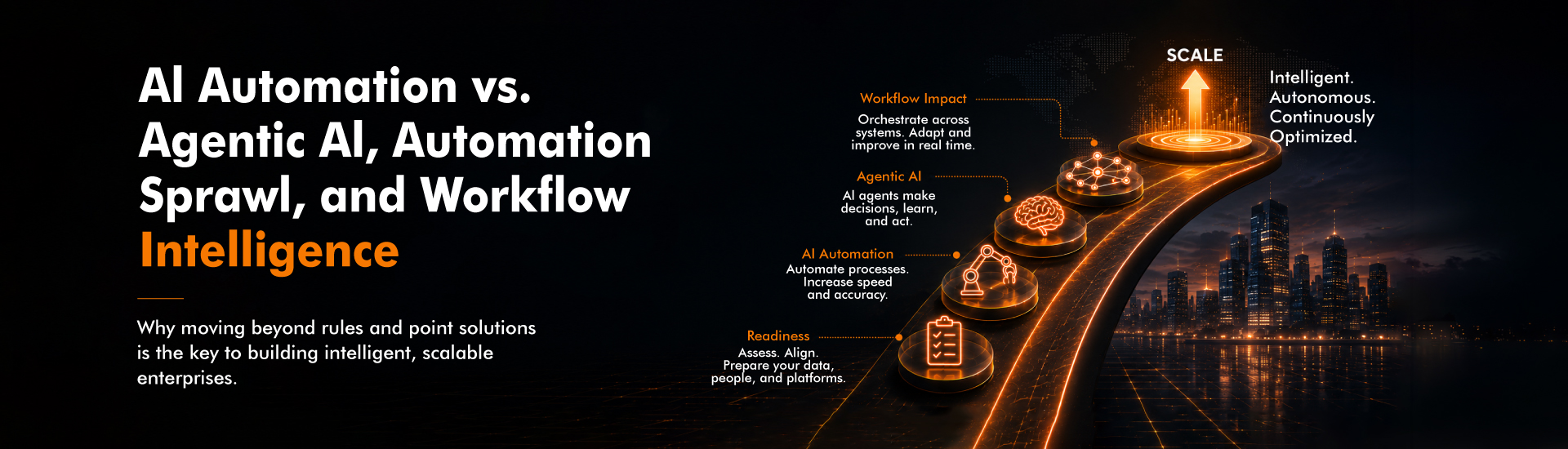
From Readiness to Scale: AI Automation vs. Agentic AI, Automation Sprawl, and Workflow Intelligence
From Readiness to Scale: AI Automation vs. Agentic AI, Automation Sprawl, and Workflow Intelligence
PART 2 OF 2 • ENTERPRISE AI SERIES
Part 1 diagnosed why enterprise AI stalls after the pilot and introduced the Six Layers of Workflow Readiness. Part 2 turns diagnosis into action — how to choose the right operating model, avoid automation sprawl, and connect intelligence to workflows.
The Story So Far
New to the series? Start with Part 1: Why AI Stalls After the Pilot.
Part 1 established that AI success depends less on technology adoption than on workflow readiness. It introduced Workflow Readiness Debt and the Six Layers of Workflow Readiness as a diagnostic model for identifying what must be prepared before automation can scale. Part 2 begins where that diagnosis ends: with the operating decisions required to move from readiness to enterprise impact.
Automation Without Readiness Creates Complexity, Not Efficiency
Automation is often presented as a straightforward path to efficiency — faster workflows, less manual effort, lower cost. In practice, the outcome is rarely that simple. Introduced into an environment with unclear ownership, inconsistent processes, or weak integration, automation does not eliminate complexity; it relocates it.
One department deploys Robotic Process Automation (RPA) to accelerate repetitive tasks; another introduces AI-driven decision support; dashboards improve. Yet the overall workflow stays fragmented because each improvement solves a local problem without strengthening the process it belongs to.
Definition: Robotic Process Automation (RPA): the use of software bots to execute repetitive, rules-based digital tasks across applications and business systems.
The result is what many organizations experience as automation sprawl: automations operate independently, data fragments across disconnected systems, and ownership blurs until teams spend more time managing the automation environment than benefiting from it. This is not a technology failure — it is a readiness failure.
So the most successful organizations ask a different question. Instead of “Can this task be automated?” they ask “Will this automation strengthen the workflow around it?” A rules-based workflow accelerated through RPA can deliver immediate value; a poorly understood process accelerated through automation simply reaches its problems faster.
Poor automation scales problems. Effective automation scales outcomes.
Once the workflow is ready, the next decision is not simply whether to automate. It is how much intelligence and autonomy the workflow actually requires
AI Automation vs. Agentic AI: Choosing the Right Operating Model.
Definition: AI Automation: using artificial intelligence within defined workflows to execute tasks, support decisions, process information, or manage exceptions with reduced manual intervention.
Definition: Agentic AI: AI systems that can pursue specified objectives, interpret context, plan or coordinate multiple actions, and adapt within defined operational and governance boundaries.
The debate is no longer whether AI should be used, but how it should participate in enterprise workflows. Traditional automation and RPA have long helped enterprises execute predefined, rules-based tasks, while AI Automation extends those workflows with capabilities such as classification, interpretation, prediction, and decision support.
Agentic AI introduces a different model: rather than simply executing tasks, agentic systems pursue objectives, evaluate context, make decisions within defined boundaries, and adapt to changing conditions.
Market attention can make Agentic AI appear to be the natural next step after conventional automation. In reality, the most effective approach depends on the maturity of the workflow. A highly structured process with clear rules and limited variability may derive substantial value from Workflow Automation, RPA, and targeted AI Automation — and introducing a more autonomous system there may add complexity without proportional value. Workflows that require dynamic decision-making, cross-functional coordination, or context-aware responses may benefit from more agentic models.
Mature organizations therefore evaluate options against workflow requirements rather than technology trends, beginning with five practical questions:
- How predictable is the process?
- How much variability exists?
- What decisions can be automated safely?
- Where is human oversight required?
- How much autonomy actually creates value?
The six-layer framework also clarifies why greater autonomy demands stronger governance, ownership, and visibility. As autonomy expands, so does the need for explicit objectives, accountability, and decision boundaries.
The smartest organizations are not choosing the most advanced AI. They are choosing the most appropriate AI for the workflow they are trying to improve.
The Future of Enterprise Operations Is Workflow Intelligence
Definition: Workflow Intelligence: the coordinated use of automation, AI, analytics, dashboards, and operational data to improve how work is executed, monitored, and managed across business processes.
Digital transformation has historically been pursued through individual technology investments — an analytics platform here, a dashboard there, RPA to accelerate repetitive activity. Each may generate value, but that value often stays localized. Sustainable automation emerges when those technologies operate as part of a connected workflow ecosystem.
That is the essence of Workflow Intelligence: combining AI Automation, Workflow Automation, Data Analytics, Business Intelligence Dashboards, and operational workflows into a coordinated decision-making framework. In this model, each capability plays a defined role:
- RPA executes repeatable tasks.
- AI supports decisions and exception handling.
- Analytics uncover patterns and trends.
- Dashboards provide visibility into operational performance.
- Workflow systems coordinate execution across teams and processes.
The value is not created by any single capability; it emerges from how effectively they work together. An enterprise can deploy many technologies and still struggle if they remain disconnected from daily operations — while a smaller, focused ecosystem aligned to clear business processes can create significant impact. Workflow Intelligence is what the six readiness layers produce when use cases, processes, data, integrations, visibility, and governance begin operating as one system. Creating that system is only the beginning. Scaling it requires enterprises to prove that the workflow remains effective as volume, variation, autonomy, and business dependence increase.
From Workflow Readiness to Enterprise Scale
Workflow readiness establishes the conditions for automation. Enterprise scale tests whether those conditions can survive greater volume, wider use, more operational variation, and increasing decision authority.
Governance becomes especially important during this transition. In a 2025 survey of 1,250 IT decision-makers, 82% said AI-related risks had accelerated the need to modernize governance, while 75% reported that team goals had shifted significantly to support faster, safer AI adoption. As automation assumes a larger operational role, accountability must expand with it.
The move to scale should therefore be treated as a controlled progression. Enterprises need evidence that the workflow produces the intended outcome, remains resilient under real operating conditions, supports appropriate human oversight, and can extend into new contexts without carrying hidden fragility with it.
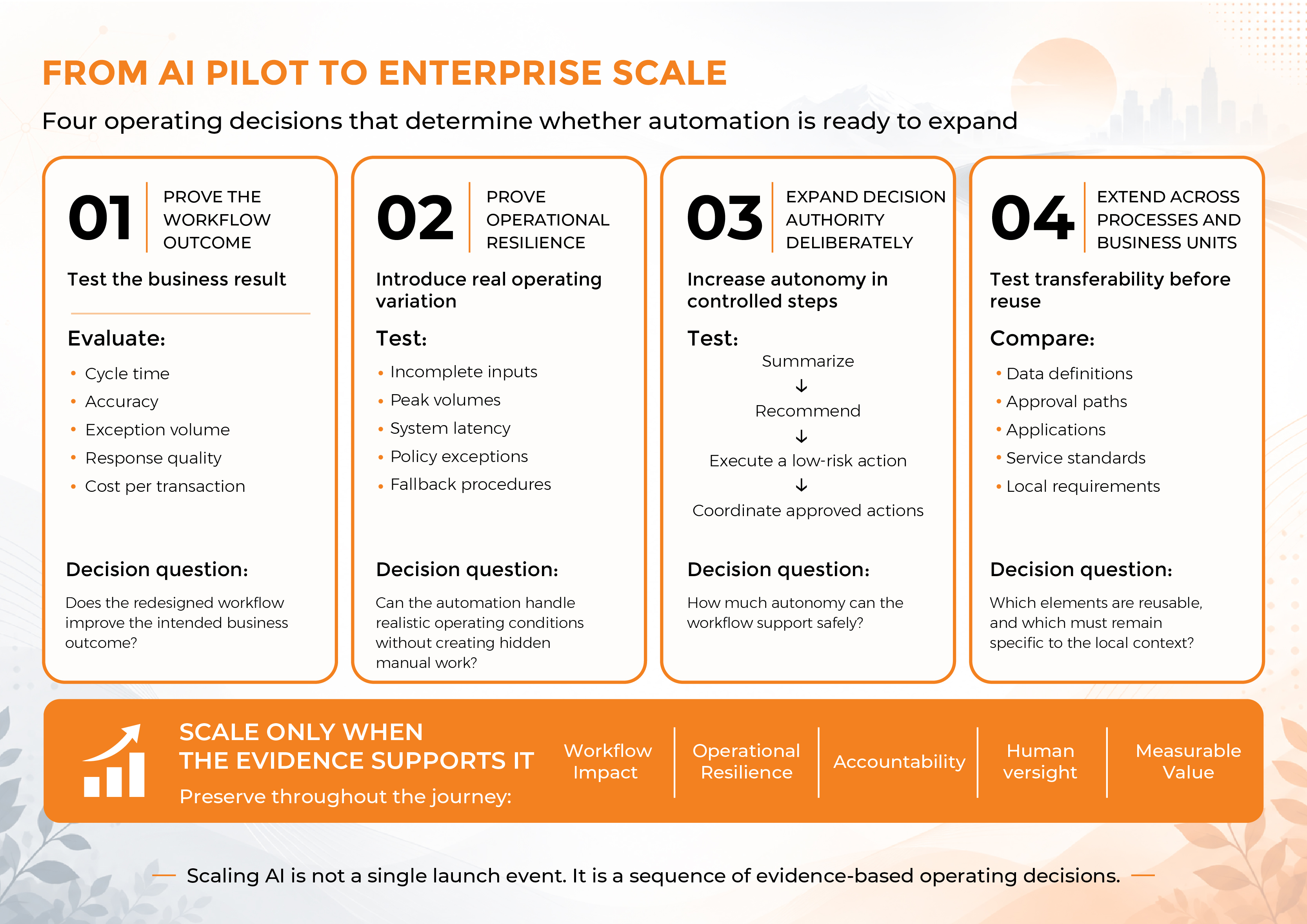
A Four-Stage Path from Pilot to Enterprise Scale
Each stage should expose the automation to a more demanding operating condition. Reach, autonomy, and business dependence should increase only when evidence from the preceding stage supports the decision.
Stage 1: Prove the workflow outcome
The first stage tests whether the redesigned workflow creates the intended result under controlled conditions. Success criteria should be business-facing: cycle time, accuracy, exception volume, response quality, cost per transaction, or another measure tied to the original problem. Technical performance remains necessary, but it cannot prove workflow impact on its own. A model may perform accurately while the surrounding process fails to improve the intended business outcome.
Stage 2: Prove operational resilience
The next stage introduces normal variation: incomplete inputs, system latency, peak volumes, policy exceptions and changes in user behaviour. Teams should observe how the automation handles failure, how quickly issues become visible, whether fallback procedures work, and whether employees know when intervention is required. This stage establishes whether the operating environment can absorb exceptions without creating hidden manual work.
Stage 3: Expand decision authority deliberately
Autonomy should increase only after decision boundaries are explicit. A sensible progression may move from summarizing information to recommending an action, executing a low-risk action, and eventually coordinating multiple actions within approved limits. Not every workflow needs to reach the final stage. The appropriate end state depends on consequence, reversibility, regulatory exposure, data sensitivity, and the organization’s tolerance for automated decision-making.
Stage 4: Extend across processes and business units
Expansion should test whether the original assumptions hold in a new context. Different teams may use different data definitions, approval paths, applications or service standards. Before extending the automation, the organization should distinguish the workflow elements that are genuinely reusable from those that must remain specific to the local operating context.
This avoids turning a successful pattern into a rigid template that forces legitimate variations into the wrong operating model.
Once automation extends across processes and business units, the unit of management must change. Leaders can no longer govern only individual projects; they must govern the automation portfolio those projects collectively create.
Managing Automation as a Portfolio
As the number of automations grows, individual project governance is no longer enough. Leaders need a portfolio view showing where automations operate, what systems and data they depend on, who owns the outcome, which controls apply, and whether value is still being realized. Without that view, duplication and dependency risk can grow unnoticed even when each local initiative appears healthy.
A portfolio register should capture more than the name of a bot or model. It should record the business process supported, the level of autonomy, material decisions influenced, human approval points, data sources, integration dependencies, service owner, monitoring measures, and a date for review. The register is not administrative documentation. The register makes it possible to compare overlapping initiatives, identify shared components, trace the impact of a system change and retire automations whose value no longer justifies their operating cost.
Portfolio governance should also distinguish three decisions that are often conflated: whether an experiment may continue, whether an automation may enter production, and whether a proven capability may expand. Each decision requires different evidence. Experimentation may tolerate uncertainty within a protected environment. Production requires reliability, accountability and support. Expansion requires evidence that the operating model remains effective at greater volume, across new contexts or with more autonomy.
Design Human Oversight into the Workflow
Human oversight is strongest when it is designed into the workflow rather than added as a final control. Teams need clarity on what information reviewers receive, how much time they have, what qualifies as an exception, and how their decisions feed back into process improvement. A human-approval step adds little value when the reviewer lacks the context, time, or authority required to challenge the system’s recommendation. The objective is meaningful oversight at the decisions where human judgement changes the risk or quality of the outcome.
Create a Continuous Learning Loop
Scaled automation should generate evidence for continuous improvement. Operational measures show where the workflow is slowing or producing exceptions. User feedback reveals where employees work around the system. Outcome measures test whether the business problem is actually improving. Governance events reveal where controls or decision boundaries need adjustment. Combined, these signals allow the organization to refine the process, data, controls, and automation as one operating system that continues learning after deployment.
Building Workflow Readiness with Vee Technologies
Building workflow readiness requires more than deploying individual tools; it requires a connected approach that aligns processes, data, decision-making, visibility, and governance before automation is scaled. Vee Technologies’ AI & Technology Services align with that need for connected readiness.
Across AI-enabled solutions, Workflow Automation, Robotic Process Automation (RPA), Data Analytics, Business Intelligence Dashboards, and Workflow Modernization, Vee Technologies helps organizations connect business processes, operational data, and decision-making more deliberately. For structured, rules-based work, RPA provides a practical automation layer. Where greater intelligence is required, AI-enabled solutions support decision-making, exception handling, and process optimization. As workflows become more data-driven, analytics and dashboards provide visibility into performance, exceptions, and business outcomes.
THE VEE POINT OF VIEW
The strongest automation initiatives are not built around technology alone. They are built around workflows that are prepared to benefit from technology.
Conclusion
Automation technologies will keep advancing. Agentic systems will become more capable, analytics more intelligent, and the range of available tools more extensive. Yet the fundamental challenge is likely to remain consistent: technology can scale only as effectively as the workflows surrounding it.
More mature enterprises treat readiness as the basis for every scaling decision. They recognize that lasting impact depends not only on what AI is capable of doing, but on whether workflows, data, ownership, integration, visibility, and governance are prepared to support it. Sustainable scale emerges when operational systems can absorb greater automation without losing resilience, accountability, visibility, or meaningful human control.
THE TAKEAWAY
The future of enterprise automation may depend less on how quickly organizations adopt AI and more on how effectively they reduce Workflow Readiness Debt before they attempt to scale it.
Frequently Asked Questions
When is RPA more appropriate than AI Automation?
RPA is usually more appropriate when tasks are repetitive, rules-based, predictable, and performed across structured digital systems. AI Automation becomes more relevant when workflows require classification, interpretation, prediction, language processing, or context-sensitive decision support. Some enterprise processes use both approaches together.
What conditions should be met before introducing Agentic AI?
Before introducing Agentic AI, an organization should define the agent’s objective, permissible actions, data access, human-approval points, escalation paths, performance measures, and accountability boundaries. Greater autonomy should be accompanied by stronger monitoring and governance, not weaker controls.
How can leaders measure whether automation is improving the workflow?
Leaders should evaluate business and workflow outcomes rather than count deployed bots or models. Relevant measures may include cycle time, exception rates, processing accuracy, intervention frequency, customer outcomes, decision turnaround, adoption, operational visibility, cost, and value delivered against the original use case.
How can enterprises prevent automation sprawl?
Diagnosing sprawl is only the first step. Preventing it requires maintaining an inventory of automations, applying shared development and governance standards, assigning process ownership, reviewing system dependencies, monitoring business outcomes, and retiring automations that no longer create value. A shared automation architecture is more sustainable than disconnected departmental deployments.