 USA (English)
 France (French)
 Japan (Japanese)
 USA (English)
 France (French)
 Japan (Japanese)
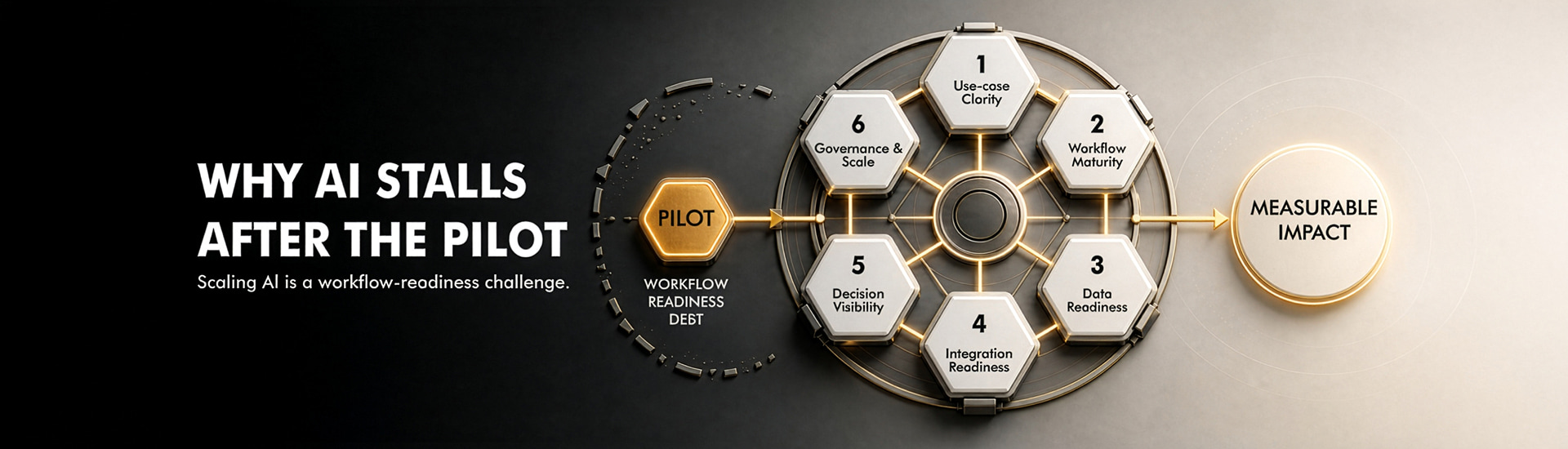
Why AI Stalls After the Pilot: Workflow Readiness Debt and the Six Layers
Why AI Stalls After the Pilot: Workflow Readiness Debt and the Six Layers
PART 1 OF 2 • ENTERPRISE AI SERIES
A practical diagnosis of why enterprise AI succeeds in pilots but struggles to scale — and the readiness conditions that separate a lasting business capability from a stalled experiment.
AI Is Accelerating. Business Impact Is Not.
Artificial intelligence has moved well beyond experimentation, and the urgency to scale intelligent capabilities keeps growing. In Bain & Company’s third-quarter 2025 survey, 74% of companies ranked AI among their top three strategic priorities — yet only 23% could connect their generative AI initiatives to increased revenue or reduced cost. That contrast captures the real gap: treating AI as a priority is not the same as converting it into measurable business impact.
Across industries, organizations are launching pilots, evaluating AI Automation opportunities, and investing in Enterprise Automation to improve productivity, decision-making, and efficiency. A curious pattern follows: many projects generate enthusiasm in the pilot phase but struggle to create meaningful impact at scale.
The issue is rarely the technology. A pilot can succeed with a small dataset, a dedicated team, and clearly defined boundaries. Enterprise-scale adoption is different — it demands that AI operate inside real workflows, depend on reliable data, and produce outcomes that can be measured consistently through reporting and governance. That is where momentum is usually lost.
The more important question is not whether AI can perform a task, but whether the surrounding business environment is prepared to support that task at scale. Ownership, process maturity, data quality, integration, and governance decide whether an AI initiative becomes a business capability or remains a pilot. In practical terms, AI readiness begins with workflow readiness.
AI success is becoming less of a technology-adoption challenge and more of a workflow-readiness challenge.
The Hidden Barrier: Workflow Readiness Debt
Definition: Workflow Readiness Debt: the accumulated gap between AI ambition and operational readiness, created by fragmented processes, unreliable data, unclear ownership, weak integration, limited visibility, and inadequate governance.
When an initiative struggles to expand beyond a pilot, the typical response is predictable: teams explore new tools, evaluate alternative platforms, or seek larger datasets. These actions may improve technical capability, but they do not necessarily improve operational readiness. The technology often matures faster than the workflow surrounding it.
Like technical debt, workflow-readiness debt accumulates gradually. A process bypasses standardization. Data is maintained differently across departments. Ownership stays undefined. Reporting becomes fragmented. Automations are deployed individually rather than as part of a connected process. Each issue looks manageable in isolation, but collectively they prevent AI, workflow, and enterprise automation from scaling.
The result is a familiar enterprise paradox: the AI models perform well, but the business outcomes do not. The intelligence of the technology is rarely the problem — the readiness of the workflow around it is.
Most AI initiatives fail not because AI cannot work, but because the workflow around AI is not ready to work.
Which raises the defining question of this series: what must be in place before AI, automation, and workflow modernization can scale successfully across an enterprise? The answer lies in the Six Layers of Workflow Readiness.
The Six Layers of Workflow Readiness
Definition: Workflow Readiness: the degree to which a business process — its data, integrations, ownership, reporting, and governance — is prepared to support automation reliably at scale.
Many organizations measure automation maturity by activity: Do we have AI tools? Have we launched pilots? Are dashboards available? A more useful question is “Is our workflow ready for AI to scale?” These six layers describe the conditions required to move from isolated pilots to measurable outcomes.
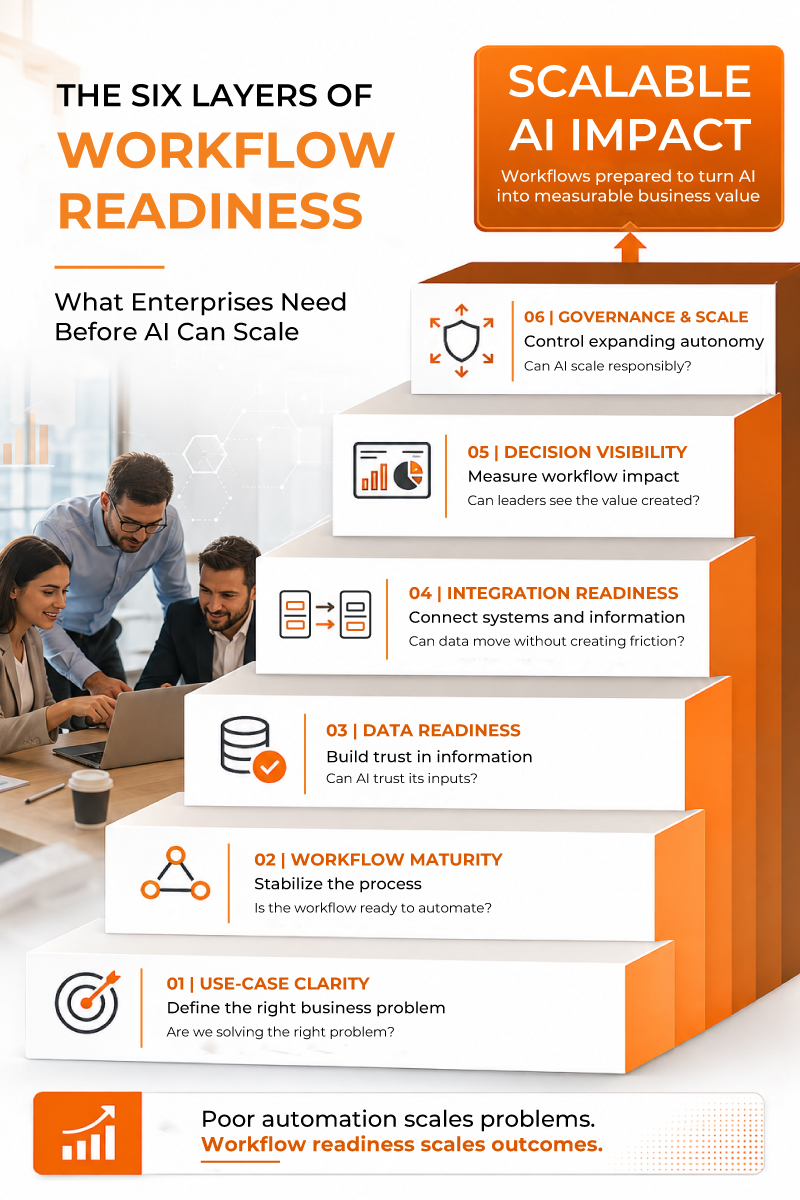
Layer 1 — Use-case Clarity
Every successful initiative begins with a clearly defined business objective, not a fascination with what AI can do. The discipline is to start with the problem — a bottleneck, decision gap, service challenge, or process delay. The objective of this layer is not technology selection; it is problem definition and selection.
Layer 2 — Workflow Maturity
Automation performs best when it enters a process that is already understood. If workflows vary across teams or locations, automation scales inconsistency rather than efficiency. Organizations must know how work moves today, where bottlenecks exist, which steps are repeatable, and which decisions require human judgment. A process that cannot be explained clearly is rarely ready to be automated at scale.
Layer 3 — Data Readiness
Even sophisticated AI produces unreliable outcomes on unreliable data. Quality, consistency, accessibility, completeness, and governance all shape results. Organizations often treat data problems as technology problems when they are really workflow problems — if information is inconsistent at the source, automation simply processes that inconsistency faster.
Layer 4 — Integration Readiness
Enterprise workflows rarely live in a single system. For automation to scale, platforms must communicate, making Data Integration a foundational requirement across business applications, workflow systems, reporting layers, and data environments. When integration maturity is weak, automation does not connect the enterprise — it re-creates its silos, only faster.
Layer 5 — Decision Visibility
Many organizations can report how many automations they have deployed; far fewer can explain how those automations influence productivity, cost, or customer experience. This is where Business Intelligence Dashboards, analytics, and reporting frameworks become critical. Automation without visibility improves activity; automation with visibility improves decisions.
Layer 6 — Governance and Scale
The final layer decides whether automation remains a pilot or becomes a sustainable capability. As initiatives expand, organizations must address ownership, accountability, compliance, change management, and performance measurement — increasingly across both traditional AI Automation and newer Agentic AI approaches.
The organizations that scale successfully are rarely those with the most advanced tools; they are the ones with the clearest governance.
Automation scales effectively only when responsibility scales with it.
Why Workflow Maturity Matters More Than Tool Selection
Of the six layers, one is overlooked more than any other: workflow maturity. Conversations about automation almost always begin with technology — which platform, which model — when success is more often determined by the maturity of the process the tool is expected to improve. A poorly understood process does not become efficient simply because AI enters it.
Organizations that scale automation successfully reverse the sequence. Before selecting a tool, they examine the process itself and ask a set of workflow-readiness questions:
• Is the workflow clearly defined, and are responsibilities understood?
• Are exceptions documented and approval paths consistent?
• Can outcomes be measured reliably?
• Is the process repeatable enough to automate?
The practical implication is straightforward: process understanding should precede platform selection. AI should not be viewed as a substitute for process discipline — it should be viewed as an accelerator of it.
Data Readiness: The Foundation Most Organizations Underestimate
Layer 3 deserves more than a paragraph, because most automation initiatives eventually reach the same realization: AI can process information far more effectively than most organizations can prepare it.
The deeper problem is trust. A 2025 benchmark of more than 150 senior data leaders found that only 1 in 5 organizations were satisfied with the accuracy and completeness of their data, and more than half either did not measure data trust or lacked confidence in it (2025 AI Readiness and Data Management Benchmark Report). That trust gap tends to surface only when a project begins to scale.
When business data lacks consistency, automation amplifies inconsistency. When reporting structures are fragmented, analytics become harder to trust. When ownership is unclear, data quality deteriorates over time. Too often this reads as an AI problem when it is, in fact, a data-readiness problem.
Data Analytics, reporting frameworks, and Business Intelligence Dashboards matter here precisely because they make the condition of the workflow visible — showing how information flows, where bottlenecks emerge, and how outcomes change over time. Mapped against the six-layer framework, data readiness supports every layer that follows: without trusted information, integration becomes difficult, reporting loses credibility, and governance weakens. AI does not eliminate the need for strong data discipline; it makes that discipline more valuable.
Turning the Six Layers into an Evidence-Based Readiness Assessment
A framework becomes useful only when teams can test it against observable evidence. A readiness review should therefore examine one defined workflow rather than assign a broad maturity label to the entire enterprise. The assessment unit might be invoice processing, customer onboarding, service-ticket triage, engineering-change control, or another end-to-end process with a named business owner. Keeping the scope specific makes gaps visible and prevents a strong capability in one function from masking a weakness elsewhere.
Start with evidence, not opinion
For each layer, reviewers should identify the artefacts that prove readiness. Use-case clarity can be evidenced through a problem statement, baseline performance and a measurable target. Workflow maturity requires a current-state process map, documented exceptions and clear hand-offs. Data readiness needs source inventories, quality rules and named data owners. Integration readiness depends on confirmed interfaces, access constraints and dependency maps. Decision visibility requires agreed measures and reporting ownership. Governance and scale require approval rights, monitoring standards, escalation routes and change-control responsibilities.
This evidence-based approach changes the conversation from “we believe the process is ready” to “we can show which conditions are ready, which are not, and what must change”. It also prevents tool demonstrations from becoming proxies for operational preparedness.
Test the weakest dependency
The six layers should not be treated as six independent checkboxes. They operate as a connected system, and the weakest critical dependency can constrain the whole initiative. A well-mapped workflow may still be unsuitable if the information required for a key decision is inaccessible. Reliable data may still fail to create value if the output reaches no accountable decision-maker. Strong governance may still slow delivery if integration dependencies are discovered only after the pilot. The review should therefore trace one proposed automation from input to decision to outcome and identify every point at which the chain could break.
Use readiness to shape the scope
A gap does not automatically mean “stop”. It should determine how the initiative is scoped. If one business unit follows a stable process and another does not, the first release can be limited to the stable unit. If historical data is dependable for only a subset of transactions, the initial model can operate within that boundary. If governance requires human approval for high-impact decisions, the first design can make recommendations rather than execute actions. In each case, readiness evidence informs a safer and more measurable starting point.
A practical readiness review should conclude with four outputs:
A concise business outcome and baseline against which value will be measured.
A map of the workflow, data, systems, decisions and accountable owners involved.
A prioritised list of readiness gaps, each linked to a remediation owner.
A release boundary that states what the automation may do, where human judgement remains, and what evidence is required before expansion.
These outputs make readiness actionable. They give business, technology, data and governance teams a common basis for deciding whether to proceed, redesign, narrow the scope or resolve a dependency before further investment.
From Diagnosis to Action
The pattern is consistent: lasting business impact depends not only on what AI can do, but on whether workflows, data, ownership, integration, visibility, and governance are ready to support it. Each of the six layers, addressed use case by use case, reduces Workflow Readiness Debt and increases the odds that automation creates durable value.
Diagnosis is only half the story. In Part 2 — From Readiness to Scale, we move from why AI stalls to how enterprises act on it: choosing between AI Automation and Agentic AI, avoiding automation sprawl, building Workflow Intelligence, and putting the six layers to work.
THE TAKEAWAY
Competitive advantage will not belong to organizations with the most AI. It will belong to those with the workflows most prepared to turn AI into measurable business impact.
Frequently Asked Questions
How should an enterprise choose its first AI automation use case?
The strongest starting use cases combine a clearly defined business problem, measurable outcomes, accessible data, manageable integration requirements, and accountable process ownership. Avoid beginning with the most technically impressive use case if its workflow is poorly understood or hard to measure.
Should organizations standardize a workflow before automating it?
Standardization should generally precede large-scale automation, but it does not require eliminating every exception. The goal is a stable core process with documented variations, defined ownership, and clarity on where human judgment must remain — so automation addresses repeatable work without hard-coding process confusion.
Can an enterprise begin AI Automation before all its data is perfect?
Shipment exceptions should be prioritized according to operational impact, time sensitivity, customer or contractual implications, information availability, and the action required. A clear prioritization model helps teams focus on consequential deviations without applying the same urgency to every status change.
Who should own workflow readiness in an enterprise?
Workflow readiness should be jointly owned by the relevant business-process leader and the technology or data teams enabling automation. Business owners define the outcome, rules, exceptions, and accountability; technical teams address data, integration, monitoring, and reliability; governance functions define the controls required for responsible scaling.