 USA (English)
 France (French)
 Japan (Japanese)
 USA (English)
 France (French)
 Japan (Japanese)
Beyond Dashboards: How Digital Twins Support Better Decisions
Dashboards are useful because they show what is happening across your system right now. But in an industrial environment, visibility is only the first step. The real value comes from knowing what to do next.
Dashboards had a good run. Let’s give them that.
But digital twins are now playing in a much bigger league. According to McKinsey, digital twins can improve decision-making by up to 90% in supply-chain settings, while the market itself could grow about 60% annually and reach $73.5 billion by 2027.
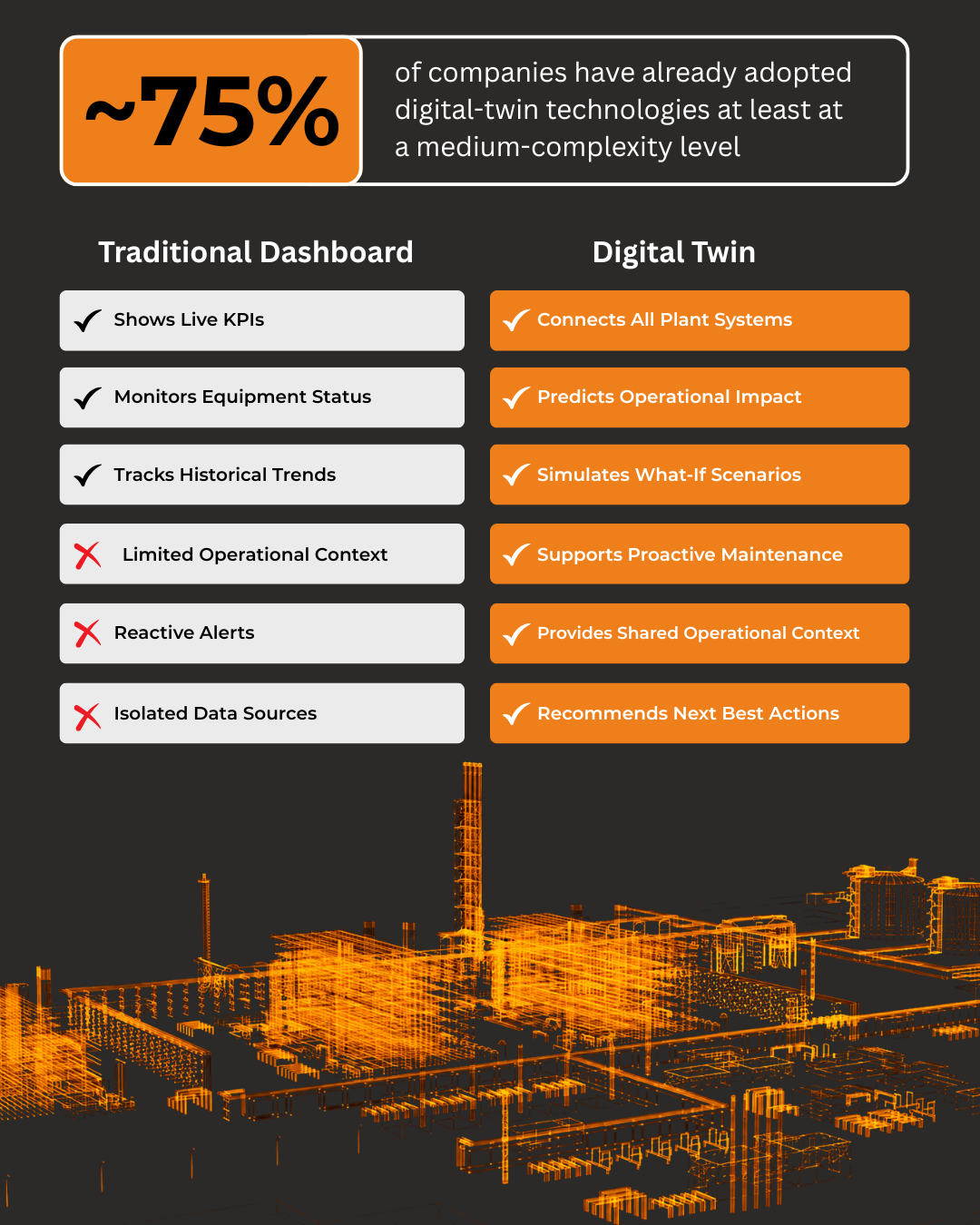
If that doesn’t signal momentum, what does? Even more telling, nearly 75% of companies have already adopted digital-twin technologies at least at a medium-complexity level. So, this is no longer a “nice to have” conversation. Digital twins are quickly becoming an operational advantage.
From Watching the Plant to Understanding It
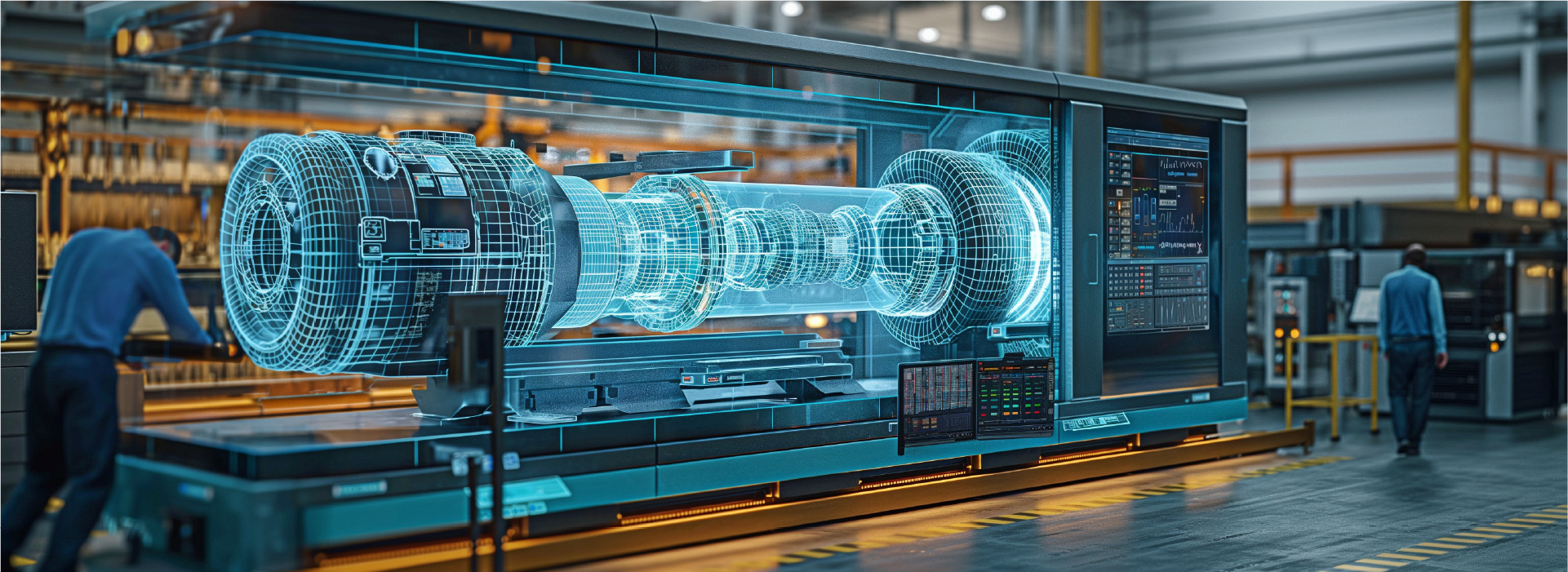
A digital twin is not just a prettier screen or a fancier control panel. It is a living, connected view of plant behavior. It brings together engineering data, operational signals, automation systems, asset information, and maintenance knowledge so teams can move from watching the plant to understanding it.
Most plants are not short on data. Many are drowning in it. Sensors are speaking. Machines are reporting. Engineering models are sitting somewhere. Control systems are doing their job. But all this information often lives in separate corners, like talented musicians playing in different rooms.
A dashboard may capture one part of the song. A digital twin helps conduct the whole orchestra.
Decision Context Is the Real Upgrade
When these streams come together, decisions stop being guesswork dressed up as experience. Teams can see how an asset is performing, how it compares with design expectations, what changed recently, and what the next practical step could be. Suddenly, the picture has depth. It has context. It has meaning.
Here’s where it gets interesting. Industrial decisions rarely affect one asset alone. A pump, compressor, boiler, conveyor, or valve does not live in glorious isolation. Each one sits inside a larger chain of production, safety, energy use, throughput, and reliability. Pull one thread, and something else may tighten somewhere else.
Seeing the Ripple Effect Before It Hits
Digital twins help teams see those relationships before they become surprises. Imagine planning maintenance and understanding the operational impact before committing resources. Or spotting a bottleneck and seeing how it may influence downstream equipment. Or reviewing plant conditions through a 3D model that gives teams a more intuitive feel for the system.
That is not passive monitoring. That is decision support with muscle.
Maintenance Moves from Late Warnings to Early Action
Now, let’s talk about maintenance, because this is where the value often becomes loud and clear.
Traditional dashboards are good at raising their hand when something has already crossed a limit. Useful, yes. But by then, the plant may already be walking toward downtime with its shoes on.
A digital twin gives teams a better chance to act earlier. By connecting real-time asset behavior with historical patterns and predictive insight, it can support a more proactive maintenance approach. Instead of waiting for failure to announce itself dramatically, teams can identify deterioration, prioritize interventions, plan work more intelligently, and reduce the risk of unplanned disruption.
That is a big shift. It changes maintenance from “What broke?” to “What is starting to move in the wrong direction?” And that one question can save time, protect uptime, and make planning far calmer.
One Operational Truth for Every Team
Better decisions are not only about machines. They are also about people.
Engineering, operations, and maintenance teams all do important work, but they may not always be looking at the same reality. Engineering understands design intent. Operations understands live performance. Maintenance understands wear, history, and what really happens on the floor.
When these perspectives stay separate, decisions slow down. Meetings multiply. A digital twin helps bring everyone closer to the same operational truth. That means fewer blind spots, faster conversations, and more confident action. Not magic. Just clarity doing its job.
Testing the Move Before Making the Move
And if that does not feel powerful enough, here’s another angle: digital twins can help teams think ahead.
The best decisions are not always made by reacting quickly. Sometimes, they are made by testing possibilities before anything physical changes. What if operating conditions shift? What if a process adjustment is made? What if equipment needs to be taken offline?
With simulation and performance analysis, digital twins can support that kind of what-if thinking. They give teams a safer space to explore options, compare outcomes, and reduce uncertainty before time, labor, and budget are committed.
Preserving Knowledge Before It Walks Out the Door
There is also the knowledge story.
Industrial plants carry years of hard-earned expertise. Some of it lives in documents. Some of it lives in systems. A lot of it lives in people’s heads. As teams change, that knowledge can become scattered or lost.
Digital twins help preserve that intelligence in a more usable form. They can support training, onboarding, maintenance validation, and system understanding through rich digital environments. Add advanced visualization into the mix, and teams get a practical way to learn the plant before stepping into complex situations.
Why Vee Technologies Fits the Decision Layer
Of course, for any of this to matter, the foundation must be trustworthy. Industrial decision-making cannot rest on fragile systems or unclear data. Digital twin environments need to be secure, scalable, reliable, and built with the realities of industrial operations in mind.
This is where Vee Technologies brings a practical engineering-first approach. The focus is not on creating a digital twin for show. It is on building connected, AI-enabled, automation-ready environments that support real-world plant decisions across design, commissioning, operations, maintenance, optimization, and training.
The Real Win: Decisions That Move Faster and Land Better
So, no, the future is not about adding more dashboards to already crowded screens.
The real opportunity is bigger than that. It is about reducing decision delays, giving teams context instead of clutter, and helping plants respond earlier, coordinate better, preserve knowledge, improve reliability, and keep performance moving in the right direction.
Dashboards will still have their place. But digital twins take the conversation further. They help industrial teams move from “Here is what we see” to “Here is what we should do next.”
And in a plant environment where every minute, every asset, and every decision can matter, that is a serious advantage.