 USA (English)
 Japan (Japanese)
 USA (English)
 France (French)
 Japan (Japanese)
The Future of Engineering Continuity: From Concept to Manufacturing
The Future of Engineering Continuity: From Concept to Manufacturing
The Real Challenge Is Engineering Continuity
Definition: Engineering Continuity is the ability to maintain connected, reliable, and decision-ready engineering information across concept development, design, simulation, prototyping, PLM, manufacturing, and plant operations.
Engineering teams don't lack speed. Mostly, they lack continuity.
Every product now sits at the intersection of mechanical systems, electronics, embedded intelligence, connectivity, sustainability mandates, and manufacturing constraints, and a decision made in week one can quietly reshape simulation outcomes, prototype behavior, and plant readiness months later.
Ask a product team what's slowing them down, and "not enough engineers" is rarely the honest answer. The honest answer is that design, analysis, validation, documentation, PLM, and Manufacturing Readiness are still operating as separate conversations rather than one continuous one.
None of this is a temporary staffing problem that another hiring cycle will fix. Products keep absorbing more disciplines into a single development cycle, and each new discipline is another place where information can be dropped between handoffs. Capacity solves for volume. It does nothing for the gaps between teams, and those gaps are where entire quarters quietly disappear.
A product can sail through every individual milestone, design sign-off, simulation approval, prototype validation, and still arrive at manufacturing having lost most of its momentum.
Speed measured stage by stage is a vanity metric; speed measured end to end, from concept to manufacturing, is the only version that matters to a launch date.
Product development becomes future-ready not when teams move faster in isolation, but when engineering intelligence stays connected from concept to manufacturing.
Engineering Drag: The Cost No One Budgets For
Definition: Engineering Drag is the accumulated loss of speed, clarity, and development confidence caused by disconnected engineering decisions, fragmented workflows, and weak alignment between design and manufacturing.
Most engineering leaders respond to delays the way they were trained to: add headcount, compress schedules, buy new tools. These interventions help at the margins.
Yet programs with strong budgets, capable engineers, and modern software still run into redesign cycles, validation bottlenecks, and last-minute manufacturing surprises. The reason isn't visible on any dashboard.
It accumulates. A model finishes on time. Simulation results land a week late. A prototype surfaces a constraint nobody flagged. Documentation falls a revision behind. Manufacturing discovers something design never saw. None of these, alone, derails a program. Together, they quietly do.
Call this Engineering Drag, the accumulated loss of speed, clarity, and confidence caused by disconnected decisions, fragmented information, and weak alignment between design and manufacturing. Like aerodynamic drag, it stays invisible until it starts eating performance.
It isn't a capability problem. It's a continuity problem, and Engineering Drag accumulates whenever product decisions outrun the information needed to validate, document, and manufacture them.
What makes drag dangerous is that it's cumulative, not linear. This is not simply a theoretical concern. According to McKinsey, approximately $30 trillion in corporate revenues over the next five years is expected to depend on products that have not yet reached the market. At the same time, product-development leaders continue to face growing complexity, tighter development cycles, and increasing expectations around performance, sustainability, and cost efficiency.
In this environment, Engineering Drag becomes more than an operational inefficiency. It becomes a business constraint.
Reducing drag, then, is not merely an efficiency initiative. It is becoming a competitive capability for organizations seeking to bring better products to market with greater confidence.
A week lost to a documentation gap in month two doesn't cost a week by month ten, it costs whatever that week has multiplied into by the time manufacturing inherits it.
Most organizations still budget for delay as if it were additive. It isn't.
Reducing drag, then, isn't housekeeping, it's becoming the sharper edge between teams that ship on time and teams that quietly, repeatedly, don't.
The Five Layers of Engineering Continuity
Organizations often measure product development through milestones: design completion, simulation approval, prototype validation, or manufacturing release.
These checkpoints indicate progress. They do not necessarily indicate continuity.
A product may successfully move through every development stage while still accumulating friction beneath the surface. The more meaningful question is not whether engineering activities are completed, but whether engineering knowledge remains connected as the product advances.
One way to evaluate this is through the Five Layers of Engineering Continuity. Together, these layers represent the progression required to transform an idea into a manufacturable product without accumulating unnecessary Engineering Drag along the way.
Layer 1: Concept Clarity
Every product begins as an engineering hypothesis.
A problem needs solving. A market opportunity emerges. A new capability is envisioned. Before design work begins, teams must align on functional requirements, operating conditions, performance expectations, cost targets, regulatory considerations, and manufacturing constraints.
When concept clarity is weak, uncertainty migrates downstream, driving additional design iterations, validation delays, and avoidable rework.
The objective of this layer is not design. It is alignment.
Layer 2: Digital Design Development
Once product intent has been established, engineering knowledge must be converted into structured digital information.
This is where CAD/CAE Services and Product Design and Development create the engineering foundation that supports everything that follows. Models, assemblies, engineering documentation, and design intelligence become the common language connecting engineering teams across the lifecycle.
Downstream decisions are often limited by the quality of the information created at this stage.
Layer 3: Simulation-Led Decision Making
A design can appear robust while still carrying hidden performance risks.
This is where Simulation Services help engineering teams evaluate feasibility, performance, reliability, durability, thermal behaviour, fluid interactions, and potential constraints before physical realities expose them later.
The role of simulation is not merely to validate designs.
It is to improve decisions.
Organizations that use simulations effectively are often able to identify risks earlier, evaluate alternatives more confidently, and reduce costly downstream changes.
Layer 4: Prototype and Validation Readiness
Eventually, every digital model must answer a simple question:
Will the product behave as expected in the real world?
This is the purpose of Prototyping and validation.
Prototype development helps teams compare engineering assumptions against measurable evidence, creating opportunities to refine designs, evaluate performance, and strengthen confidence before production commitments are made.
At this stage, engineering confidence begins to move from prediction to proof.
Layer 5: Manufacturing and Plant Intelligence
The final layer extends engineering continuity beyond successful design and validation.
A product may perform perfectly in testing yet still encounter challenges during production if engineering data, tooling requirements, plant constraints, manufacturing workflows, and operational expectations are not aligned.
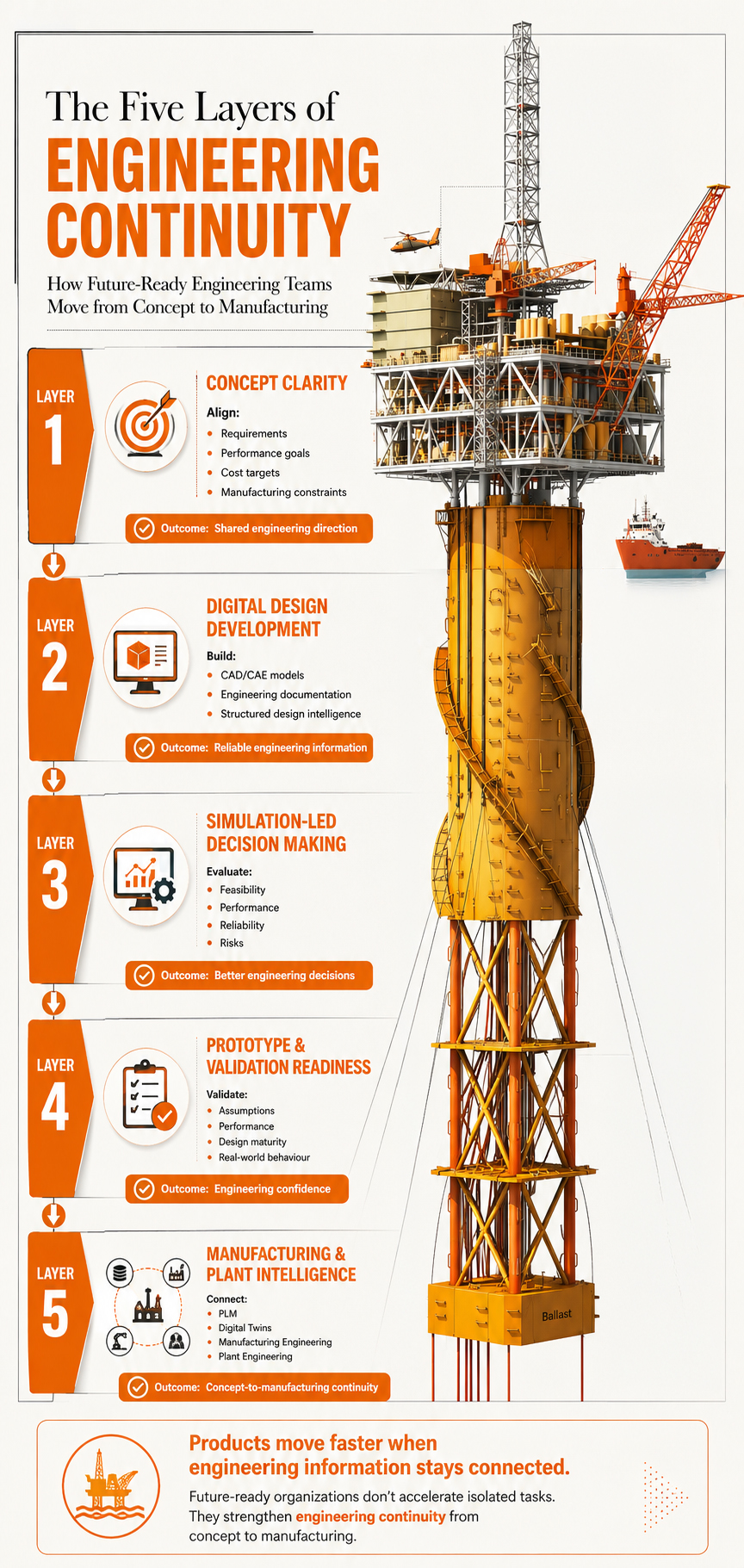
This is where PLM, Digital Twins, Plant Engineering Solutions, and Manufacturing Engineering become increasingly important.
Definition: Product Lifecycle Management (PLM) is the discipline of managing product information, documentation, configurations, engineering changes, and workflows throughout the product lifecycle.
Rather than treating manufacturing as a downstream activity, future-ready organizations connect engineering and manufacturing much earlier in the lifecycle, ensuring that decisions remain visible from concept through production and beyond.
Manufacturing readiness is not the end of the engineering lifecycle. It is proof that engineering continuity has survived it.
Viewed together, these five layers reveal a simple but powerful reality:
Products move faster when engineering information remains connected.
Future-ready organizations are not focused solely on accelerating individual activities. They are focused on strengthening engineering continuity across the entire journey from concept to manufacturing.
Five checkpoints, one throughline: each layer inherits the clarity, or the confusion, the one before it produced. The rest of this argument follows that throughline forward, from decision-making at the design desk to advantage on the factory floor.
From Design to Decision Intelligence
CAD/CAE Services used to mean drawings and assemblies. That framing is outdated. A well-built digital model is a shared reference for designers, analysts, prototype teams, manufacturing engineers, and suppliers alike; engineering information that gets reused and refined rather than recreated at every handoff.
This is also where modern engineering organizations are rethinking the role of CAD and CAE. Beyond creating geometry, these environments help establish design intent, configuration control, engineering documentation, analysis readiness, and data consistency across teams.
When design information is structured effectively, it becomes easier to support simulations, prototype development, manufacturing planning, and lifecycle management without repeatedly recreating engineering knowledge.
In this sense, CAD/CAE serves not merely as a design environment, but as the information backbone that enables engineering continuity across the product lifecycle.
The purpose of modern CAD/CAE is not to produce designs. It's to produce engineering knowledge that keeps paying dividends across the lifecycle.
Simulation Services have undergone a similar promotion. Once a late-stage checkpoint before physical prototyping, simulation now does its most valuable work early, because the cost of catching a flaw rises sharply the further a product travels toward production.
Structural behavior, thermal performance, fluid dynamics: modeling these digitally lets teams compare alternatives before committing real budget to any one of them.
Simulation earns its value not by confirming a decision, but by preventing a bad one from surviving long enough to become expensive.
The two capabilities are converging for a reason. A digital model that can't be simulated efficiently is just documentation; a simulation built on a poorly structured model produces answers nobody trusts.
Teams that treat CAD and CAE as a single continuous discipline, rather than a handoff between a design function and an analysis function, consistently cut the number of iteration loops needed to reach a design they'd actually commit to production.
Within the Five Layers, simulation is the bridge between design intent and physical proof, engineering foresight standing in for what used to be engineering verification.
From Validation to Lifecycle Intelligence
Prototyping remains where digital confidence meets physical scrutiny, not a stage that follows design, but a feedback loop that improves it. Test results refine simulations; simulation findings sharpen prototype priorities.
But validation, on its own, is still a snapshot, a single measured moment in a product's life. The bigger shift underway is what happens after that snapshot.
Digital Twins turn engineering knowledge from something that goes quiet after design sign-off into something that stays active for the life of the product. A digital twin fuses engineering models, operational data, and simulation insight into one live environment; connecting decisions made at the drafting stage to performance data collected years into operation.
Definition: A Digital Twin is a connected digital representation of a product, asset, system, or plant that combines engineering models, operational data, and lifecycle intelligence to improve decision-making and performance
For industrial environments, this becomes especially important because plant data, automation systems, asset behavior, maintenance information, and engineering models must work together to support safer, more reliable, and more predictive operations.
The question engineering teams can ask changes accordingly: not "what happened," but "what is happening"; and eventually, "what happens next."
A maintenance pattern surfacing across a fleet of assets in year three can be traced back to a tolerance decision made at the design desk in year one, a link that simply didn't exist when engineering data stopped moving the day a product shipped.
According to McKinsey, product-development leaders increasingly treat digital twins as a route to faster cycles and better products; part of a broader shift in which 75% of product-development executives now name further digitization a key priority.
The Digital Thread carries this connectivity further still, linking product data across design, manufacturing, service, and retirement so nothing goes stale the moment a phase closes.
Definition: A Digital Thread is the continuous flow of engineering and product information across design, development, manufacturing, operation, service, and retirement stages.
Research from Tech-Clarity found that top-performing organizations are 2.6 times as likely to view the digital thread as critical to supporting business strategy. The findings reinforce a growing reality: engineering continuity is no longer simply an engineering objective. It is increasingly becoming a business objective.
PTC frames PLM as the foundation this thread runs on, and the numbers back the framing. Without that connective backbone, a digital twin is just an expensive, disconnected model; with it, the twin becomes the live interface between what was designed and what is actually happening in the field.
Put together, prototyping, digital twins, and PLM form a single arc: validation stops being a checkpoint and becomes a continuous source of engineering intelligence.
This is the point where "engineering continuity" stops describing a process and starts describing an asset, one that compounds in value every quarter the product stays in the field, because every operating hour feeds information back into decisions the next product generation will make.
From Manufacturing to Competitive Advantage
Manufacturing teams inherit whatever the earlier stages left unresolved. A design that's technically sound can still be difficult to build. Documentation can lag behind the latest change. Tooling requirements often surface only after they're expensive to fix.
Engineering Drag doesn't disappear at this stage, it simply changes address.
Treating Manufacturing Engineering and Manufacturing Readiness as continuity, not as the last box to tick, means pulling jigs, fixtures, CNC programming, and plant layout into the conversation earlier, while design decisions are still cheap to adjust.
A tooling requirement flagged during digital design costs a design tweak. The same requirement discovered after tooling is cut costs a re-fabrication, a schedule slip, and an uncomfortable conversation with whoever approved the launch date.
Manufacturing readiness is not created on the factory floor. It's built through every engineering decision that preceded it.
Plant Engineering Solutions extend that logic one step further, into environments that never stop changing: equipment layout, utilities, safety systems, and compliance requirements that must all function together, not just individually.
A technically sound product can still create operational friction if plant realities were never part of the design conversation, a fixture that assumes floor space nobody has, a process that assumes utilities the plant doesn't run.
Vee Technologies' plant engineering work spans concept, FEED, detailed design, execution, and long-term operability, treating the plant floor as an extension of engineering rather than something engineering hands off to.
This is where the fifth layer proves itself: decisions engineered correctly, validated physically, and documented properly still have to earn their keep in the place where products actually get built.
And this is also where continuity quietly turns into competitive advantage. Two competitors can launch technically identical products; the one that engineered its plant alignment three stages earlier will be shipping at scale while the other is still debugging its own production line.
Organizations that connect product and plant thinking this early aren't just avoiding rework, they're compounding an advantage competitors won't see until it's too late to close.
What Future-Ready Engineering Teams Do Differently
The teams that consistently outpace their peers rarely have the biggest budgets or the newest software. They've simply stopped optimizing individual disciplines and started optimizing the connections between them. Design teams used to own design. Analysts owned simulation. Manufacturing owned production.
That division made sense when products were simpler, it doesn't anymore. Regulatory scrutiny, sustainability reporting, and embedded software now touch every one of those functions at once, and a team still organized around 20th-century handoffs will feel each new requirement as friction rather than routine.
CAD/CAE is becoming an information platform rather than a drafting tool. Simulation has become a decision mechanism rather than a testing gate. Digital twins have pushed engineering visibility well past the design phase and into live operations.
PLM and digital-thread thinking preserve continuity across all of it. The question worth asking has shifted from "what comes next" to "how does this decision affect every stage that follows it?"
That single reframe is doing more to reduce Engineering Drag than any individual tool ever will. It's also harder to copy than a tool. A competitor can buy the same simulation license or the same PLM platform in a fiscal quarter.
Rebuilding the habits, reporting lines, and decision rights that make continuity the default rather than the exception takes considerably longer, which is precisely why it's emerging as the harder competitive advantage to replicate.
Building Engineering Continuity with
Vee Technologies
Building engineering continuity requires more than adding capacity at isolated stages of the product lifecycle. It requires connected capabilities that help product teams move from concept definition to digital design, simulation, validation, plant alignment, and manufacturing readiness with greater clarity and control.
This is where Vee Technologies' Engineering Solutions become strategically relevant.
Rather than treating engineering as a sequence of disconnected activities, Vee Technologies helps organizations strengthen continuity across three interconnected dimensions:
Design and Analysis
From Product Design and Development and CAD/CAE Services to engineering analysis, FEA, CFD, reverse engineering, and design optimization, Vee helps organizations establish the engineering foundation required to move concepts toward validated designs.
Digital and Lifecycle Intelligence
Through Digital Engineering Solutions, Digital Twins, PLM, and digital-thread-enabled workflows, Vee helps connect engineering models, operational data, lifecycle information, predictive insights, and decision-making across the product journey.
Definition: Digital Engineering uses digital models, simulations, engineering data, and connected workflows to improve design, validation, manufacturing readiness, and lifecycle decision-making.
Manufacturing and Plant Readiness
With Prototyping, Plant Engineering Solutions, & Manufacturing Engineering, Vee helps bridge the gap between engineering intent and execution by aligning validation, production planning, tooling, plant requirements, constructability, safety, and long-term operational performance.
Viewed together, these capabilities function as more than individual service offerings. They form an engineering-continuity ecosystem designed to help organizations maintain visibility, confidence, and alignment from concept to manufacturing.
In a future-ready engineering environment, the goal is not simply to complete each phase efficiently. The goal is to ensure that every phase strengthens the next.
Conclusion
The future of product development will not be defined solely by how quickly engineering teams complete individual tasks. It will be defined by how effectively engineering intelligence remains connected across the lifecycle.
As products become more complex and development environments become increasingly interconnected, organizations can no longer afford disconnected decisions across design, simulation, validation, manufacturing, and operations. Every break in continuity creates friction. Every lost insight increases uncertainty. Over time, these gaps accumulate as Engineering Drag.
Future-ready organizations are responding by building stronger connections between CAD/CAE Services, Simulation Services, Digital Engineering Solutions, Digital Twins, Prototyping, PLM, Manufacturing Engineering, and Plant Engineering Solutions. Their objective is not simply to accelerate engineering activities, but to preserve engineering continuity from concept to manufacturing and beyond.
Engineering advantage may increasingly depend less on speed alone and more on continuity: the ability to keep product intelligence connected from the first concept decision to the realities of production, operations, and long-term performance.
Continuity, not speed, is the harder capability to build, and ultimately the harder capability to replicate.
FAQs
Why is Engineering Continuity important in product development?
Engineering Continuity helps reduce engineering drag, prevents information silos, improves collaboration, and enables organizations to move products from concept to manufacturing with greater confidence.
How do Simulation Services improve product development?
Simulation Services allow organizations to evaluate performance, feasibility, durability, thermal behavior, structural integrity, and other engineering variables before committing to physical prototypes or production.
How does PLM support manufacturing readiness?
PLM helps maintain trusted product information, manages engineering changes, controls documentation, and ensures continuity between design, validation, manufacturing, and lifecycle activities.
What is a Digital Thread?
A Digital Thread connects product data across design, manufacturing, service, maintenance, and lifecycle stages, helping teams access reliable information throughout the product lifecycle.
How do Plant Engineering Solutions support product development?
Plant Engineering Solutions help align engineering decisions with production realities, including plant layouts, utilities, safety, operability, maintenance requirements, and long-term performance objectives.
How is Engineering Continuity different from PLM?
Engineering Continuity is the broader objective of keeping engineering knowledge connected across the product lifecycle. PLM is one of the systems that helps organizations achieve that continuity by managing product information, configurations, documentation, and engineering changes.
When should simulation begin in the product-development lifecycle?
Simulation delivers the greatest value when introduced early. Using simulation during concept evaluation and design development helps organizations identify performance risks, compare alternatives, and improve decision quality before costly downstream changes become necessary.
What business benefits do Digital Twins provide?
Digital Twins can improve visibility into product and asset performance, support predictive decision-making, enhance operational reliability, reduce unplanned downtime, and help organizations create stronger connections between engineering and operations.
Why do manufacturing issues often originate earlier in development?
Many manufacturing challenges originate during concept, design, or documentation stages. Incomplete engineering information, late design changes, weak configuration control, and poor production alignment can create downstream manufacturing constraints that become more expensive to resolve later.