 USA (English)
 France (French)
 Japan (Japanese)
 USA (English)
 France (French)
 Japan (Japanese)
Why a Complete BIM Model Is Not a Verified Model
A finished-looking BIM model may contain the expected geometry, information, and documentation without establishing that these elements satisfy the requirements governing its intended use. What is missing is assurance.
A Finished Model Can Still Be Unready for Reliance
Visible completion says little about whether the information can support the decision another team is about to make. Procurement teams may draw quantities or package requirements from the model. Contractors may use model-derived documentation to plan execution, and handover teams may depend on embedded information for later asset use. Each form of reliance asks something different of the model.
A missing parameter, an unresolved inconsistency, or a mismatch between the model and related documentation may remain hidden behind an otherwise complete-looking delivery. More geometry and data can even strengthen confidence before anyone has established whether the right requirements were checked.
A model can be complete without being ready to rely on.
Completion and Verification Answer Different Questions
A completed model and a verified model describe different conditions. Completion asks a delivery question: has the required package been created? Verification asks a reliance question: what has been checked, against which criteria, and for which decision?
Definition: Model Completeness and Model Verification: Model completeness indicates that expected deliverables have been produced for a defined stage. Model verification examines the model against defined project requirements, information conditions, and review criteria for the intended use.
Delivery status cannot establish suitability by itself. A model may contain the expected objects yet lack required attributes. Drawings may have been issued while information remains inconsistent across related deliverables. A coordination review may be complete without addressing every criterion that a given use requires.
Verification is therefore bounded by purpose and scope. It does not certify the model for every application or guarantee that every issue has been identified. It establishes what was examined, which criteria governed the review, and where limitations or unresolved conditions remain.
The Assurance Layer
Verification needs a defined way to connect delivered information with the decision it is expected to support. In this article, that connecting process is called the Assurance Layer.
Definition: The Assurance Layer: The Assurance Layer is the structured checking process between model delivery and downstream reliance, examining whether geometry, information, documentation, coordination conditions, and specified criteria align with defined project requirements and intended use.
The process runs at defined information exchanges, before anyone relies on the model. Its depth should reflect the project stage, purpose, review scope, and consequence of reliance. It may involve the delivery team’s internal QA/QC, an independent BIM model audit, or a defined combination of both.
Independence changes the perspective of the review, not the underlying project responsibilities. A reviewer separated from model production may test assumptions, information conditions, and deliverable criteria without having authored the work. The project still needs to define what independence means, which criteria apply, which information is available, and who may act on the findings.
Assurance also depends on controlled information management. ISO 19650-1 provides principles for managing information across a built asset’s lifecycle, including its exchange, recording, versioning, and organization. The Assurance Layer responds to that need for defined information conditions; it is not an ISO term or prescribed stage.
The concept does not certify the model, transfer design responsibility, replace professional judgment, or guarantee that every issue has been found. Nor is it another name for clash detection. It creates a documented basis for deciding whether the model can be relied upon as delivered, requires correction, needs qualification, or calls for further review.
The Five Checks of the Assurance Layer
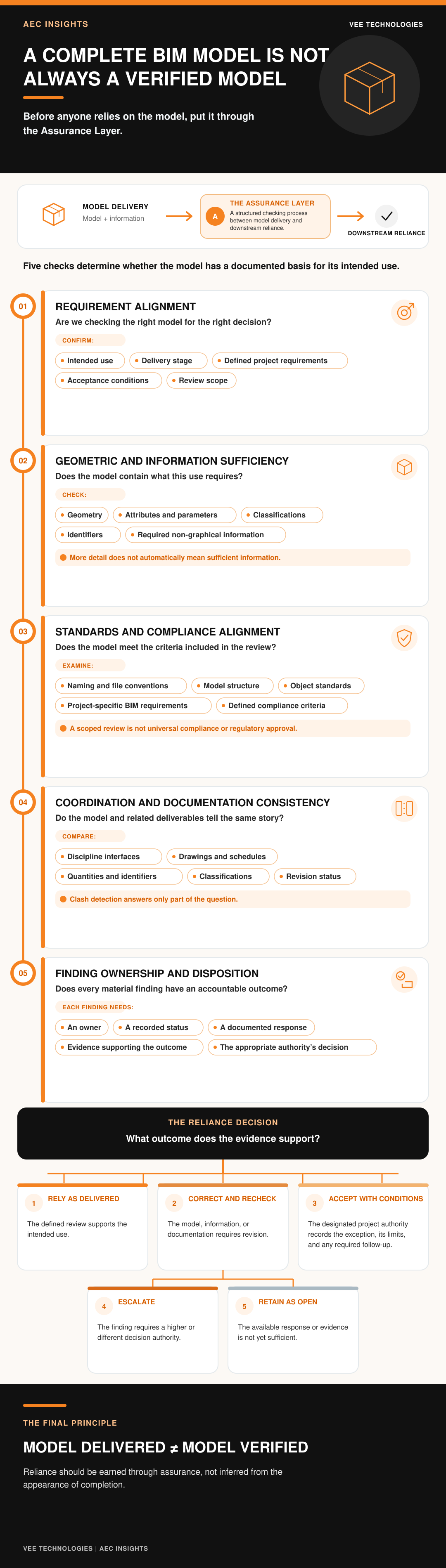
The Assurance Layer works through five checks that connect defined requirements to model review, documented findings, and an explicit reliance decision. The checks are complementary: no single result establishes that a model is suitable for every use.
Requirement Alignment
Are the intended use, delivery stage, defined project requirements, acceptance conditions, and review scope clear before checking begins?
This check sets the reference point. Before reviewing the model, the team needs to know which exchange is being reviewed, who will rely on it, which requirements govern that use, what acceptance means, and what sits outside the review. Without that basis, even rigorous checking can answer the wrong question.
The same model may therefore require different review criteria at different exchanges.
Geometric and Information Sufficiency
Are model geometry and non-graphical information sufficiently developed for the intended purpose?
The review considers whether required elements, attributes, parameters, classifications, and identifiers are present and suitable for the defined use.
Standards and Compliance Alignment
Does the model align with the standards, conventions, rules, and specified compliance criteria included within the defined review scope?
Reviews under this check may cover naming, classification, file and model structure, object standards, project-specific BIM requirements, or defined code-related criteria. The result applies only to what was included in scope. It does not constitute regulatory approval, universal compliance, or certification of the complete model.
Coordination and Documentation Consistency
Do the model, discipline interfaces, drawings, schedules, and related documents provide a consistent basis for the intended downstream use?
The review may compare model information with drawings, schedules, handoffs, and discipline interfaces to identify specified conflicts or inconsistencies. Clash detection can support this check, but spatial coordination answers only part of the question. The review also looks at identifiers, dimensions, quantities, classifications, and revision status wherever they affect the defined use. A coordinated geometry set can still leave conflicting or incomplete information elsewhere in the delivery package.
Finding Ownership and Disposition
Can every material finding be assigned, tracked, and either closed, explicitly accepted, escalated, or retained as open by the appropriate authority?
A material finding needs an identifiable owner, recorded status, and documented outcome. An unresolved finding leaves the basis for reliance incomplete. The full path from identification to correction, acceptance, or escalation is set out below.
More Detail Does Not Automatically Create More Assurance
A model can become richer without becoming more suitable for the decision ahead. Added geometry may improve visual definition, while the non-graphical information required for quantities, specifications, handover, or asset use remains incomplete, inconsistent, or outside the defined review scope.
Definition: LOD and LOI: Terminology varies across markets and standards. In this article, LOD refers to the required development and reliability of model geometry, while LOI refers to the required non-graphical information for the defined use.
In practice, geometry may show the form, location, size, or relationship of an element. Non-graphical information may carry classification, performance, product, identification, maintenance, or other required data. Neither category should be judged by volume alone. Its sufficiency depends on the project stage, intended use, defined project requirements, and applicable information exchange. A less visually detailed object may therefore be sufficient when its geometry and associated information meet the defined requirement.
BIMForum’s 2025 LOD Specification presents LOD as a reference for communicating model-element characteristics. It also cautions that its illustrations do not establish fitness for a particular project or code or design compliance. LOD can clarify what a model element represents; it does not independently verify the complete model.
UK BIM Framework guidance uses the broader concept of level of information need within its treatment of information requirements for particular purposes and exchanges. This supports the article’s central question: whether the required graphical and non-graphical information fits the use being considered.
One Complete Model, Two Reliance Decisions
Consider a multidisciplinary model package that has reached its expected delivery stage. The required files are present, drawings and schedules have been issued, and the package appears complete. One schedule quantity, however, does not align with the information represented in the model.
In the completion-based path, the package is relied upon in good faith because the expected deliverables exist and no visible condition prevents use. The inconsistency surfaces only after the schedule has informed a downstream decision. At that point, the team must determine which information governed the decision, whether the model or schedule requires correction, who owns the response, and whether related outputs are affected.
In the assurance-based path, a reviewer identifies the same inconsistency before anyone relies on the package and records it against the applicable requirement. The finding is assigned to an owner. The model, schedule, or both are corrected, or the designated project authority formally accepts the exception. Either way, the outcome stays in the review record.
Neither path guarantees that every issue will be found or that later change will be avoided. The difference is not whether the model contained an issue. It is whether that issue became visible, owned, and dispositioned before the model was relied upon.
From Identification to Disposition
That difference depends on what happens after a finding is raised. A comment left in a screenshot, email, markup, or issue log may identify a problem, but it does not establish who must respond, what evidence will demonstrate resolution, or who can accept a remaining exception.
Definition: Verification Finding: A verification finding is a recorded inconsistency, omission, non-conformance, or information gap linked to a review criterion and requiring an owner, response, status, and closure evidence or formal disposition.
The lifecycle begins by linking the finding to the applicable requirement or review criterion. Its downstream significance is then assessed, a responsible party is assigned, and the required response is recorded. Once the model, information, or document has been corrected, the supporting evidence should be reviewed before the status changes.
Closure is not the only legitimate outcome. A finding may be corrected, accepted with a documented qualification, escalated for further decision, or remain open when the response is insufficient. Formal disposition means that the designated project authority has recorded the outcome and any conditions attached to it.
Accepted findings should not disappear from the record. The disposition should preserve the reason for acceptance, the authority granting it, any limits placed on reliance, and any later action required. Otherwise, an accepted exception can become indistinguishable from an overlooked issue.
Identifying a finding does not give the reviewer authority to approve its disposition. The reviewer establishes what was observed and against which criterion; the responsible party prepares the response; and the designated project authority decides whether the evidence supports closure, acceptance, escalation, or further action.
As model information moves through design, procurement, delivery, handover, and later asset use, the history of findings and their outcomes becomes part of the information trail. Kept consistently, that record shows later users what was checked, what was accepted, and why.
A verification finding creates value only when ownership and disposition are explicit.
Supporting the Assurance Layer with Vee Technologies
External BIM support can strengthen an assurance process by adding review capacity, specialist checking, and documented findings without taking on the client’s final reliance decision.
Vee Technologies’ BIM design and consulting capabilities include BIM model auditing, BIM Execution Plan development, model templates, BIM content, and clash detection and resolution. Its data-rich design and modelling services can also assess current digital models against lifecycle requirements and report gaps between the model and those requirements.
Its published guidance on BIM implementation and quality assurance describes QA/QC checklists developed around client standards and specifications, supported by templates, quality metrics, review updates, and a Plan-Do-Check-Act process. In a separate stadium MEP point-cloud case study, it documents mismatch and missing-element detection, reporting, iterative clash resolution, multidisciplinary coordination, and delivery of an LOD 350 model.
Against the Five Checks, BIM Execution Plan development and lifecycle-requirements assessment support Requirement Alignment, and QA/QC checklists built on client standards support Standards and Compliance Alignment. Mismatch detection and clash resolution support the coordination component of Coordination and Documentation Consistency.
These examples illustrate relevant checking and correction practices; neither represents universal model verification. The engagement scope must still define which requirements, information conditions, documents, and findings Vee Technologies will review.
Design responsibility, contractual decisions, regulatory obligations, acceptance of exceptions, and final approval remain with the client or designated project authority.
Conclusion: Reliance Must Be Earned
BIM models will continue to carry richer geometry, information, and documentation. That richness can support decisions without removing the need for defined checking, visible limitations, and accountable disposition.
A verified model has a documented basis for its intended use and makes no promise of universal correctness.
Reliance should be earned through assurance, not inferred from the appearance of completion.
Explore Vee Technologies’ AEC Services or discuss BIM model auditing and QA/QC support for your next BIM deliverable.
Frequently Asked Questions
When should model-verification criteria be defined?
Criteria should be defined before the information exchange to which they apply, ideally when the intended use, information requirements, and acceptance conditions are established. Defining them only after delivery can turn verification into a subjective search for defects rather than a controlled assessment against known expectations.
Is BIM model verification the same as clash detection?
No. Clash detection examines specified spatial conflicts between model elements or disciplines. Verification may use clash results as one input, but it also asks questions clash detection cannot answer, such as whether the model matches its drawings and schedules and who owns each finding.
Does a more detailed BIM model require less verification?
Not necessarily. Verification depth follows the consequence of reliance and the project stage, however detailed the model is. A model used only for visualization may require different checking from one supporting quantities, construction documentation, fabrication, handover, or asset information.
What should happen when the BIM model and drawing set conflict?
The conflict should be recorded as a verification finding and referred to the applicable contractual requirements and information-governance procedure. An owner should investigate and respond. The designated project authority then determines which information governs, within any contractual order of precedence, and whether correction, clarification, or formal acceptance is required.
Who should own and close model-verification findings?
The party responsible for the affected model, information, or document owns the response. Closure or formal acceptance belongs to the project authority designated by the contract, governance plan, or review procedure. That designation, including any delegation, should be settled in advance. The reviewer records the finding but does not close it by default.
How should external BIM support preserve client approval authority?
The client and external partner should define the review scope, criteria, information sources, deliverables, ownership, escalation route, and acceptance authority before checking begins. The final record should separate what the external reviewer found from the corrections made by the responsible party and the exceptions and approvals decided by the designated project authority.