
 USA (English)
 Japan (Japanese)
 USA (English)
 France (French)
 Japan (Japanese)

Project Friction Starts Long Before Construction: Why BIM-Led Coordination Has Become an Execution Imperative
Project Friction Starts Long Before Construction: Why BIM-Led Coordination Has Become an Execution Imperative
Project Friction Often Begins Before Construction Starts
Every construction project is ultimately judged by what happens on-site. Delays, rework, RFIs, schedule disruptions, and cost overruns are typically viewed as execution problems. Yet by the time many of these issues emerge, their underlying causes have already been embedded into the project.
The modern built environment is no longer a collection of isolated disciplines. According to Autodesk and FMI research, poor project data and communication practices can contribute to significant project inefficiencies, highlighting the growing need for coordinated project environments.
Architectural intent, structural requirements, building services, construction sequencing, sustainability goals, regulatory obligations, and stakeholder expectations must function as an interconnected system. The challenge is not merely designing each element correctly. It is ensuring they work together before execution begins.
As projects become more complex, even well-developed designs can generate downstream friction when decisions are made without sufficient visibility into their wider implications. A seemingly minor architectural adjustment can affect structural requirements. A structural modification can influence service routing. An MEP revision can alter installation sequences, maintenance access, or future building operations.
This creates a perspective shift that many project teams overlook.
Construction problems are often treated as failures of execution. In reality, they are frequently failures of coordination that remain hidden until execution exposes them.
Construction problems are frequently symptoms of coordination problems.
That distinction matters because once friction reaches the construction phase, resolving it becomes significantly more expensive and disruptive than preventing it during planning and coordination. Improving project outcomes therefore begins not with reacting to problems in the field, but with reducing the conditions that allow those problems to develop in the first place.
The Hidden Driver of Project Friction
When Information Is Connected but Decisions Are Not
The visible signs of project friction are familiar to every AEC professional: design revisions, RFIs, documentation inconsistencies, late-stage clashes, schedule disruptions, and field modifications.
What is often less visible is the chain of decisions that creates them.
Modern projects bring together architects, engineers, MEP specialists, contractors, owners, consultants, and regulatory stakeholders. Each participant contributes valuable expertise and may produce high-quality work within their scope. Yet project friction can still emerge when decisions made within those individual scopes fail to connect effectively with one another.
The problem is not always inaccurate information.
More often, it is incomplete visibility.
A structural engineer may optimize a design for performance. An architect may prioritize functionality and aesthetics. An MEP team may focus on efficient system routing. Independently, these decisions can be entirely reasonable. Collectively, they can introduce constraints that remain hidden until later project stages.
As these unresolved dependencies accumulate, they create what may be described as coordination debt: the gradual build-up of assumptions, conflicts, and disconnected decisions that are carried forward into documentation, procurement, and construction.
Like financial debt, coordination debt may appear manageable in the early stages. Over time, however, interest accumulates in the form of rework, delays, redesign efforts, and avoidable project risk.
This creates an important shift in how coordination should be viewed.
Rather than a final design-review activity, coordination increasingly functions as a project-readiness discipline that influences constructability, documentation quality, execution confidence, and overall project predictability.
Rework is rarely created when it appears. More often, it is created when disconnected decisions remain undiscovered.
Understanding this distinction is critical because reducing project friction requires more than identifying problems. It requires creating visibility into how decisions across disciplines influence the project as a whole.
A Better Way to Evaluate Project Readiness
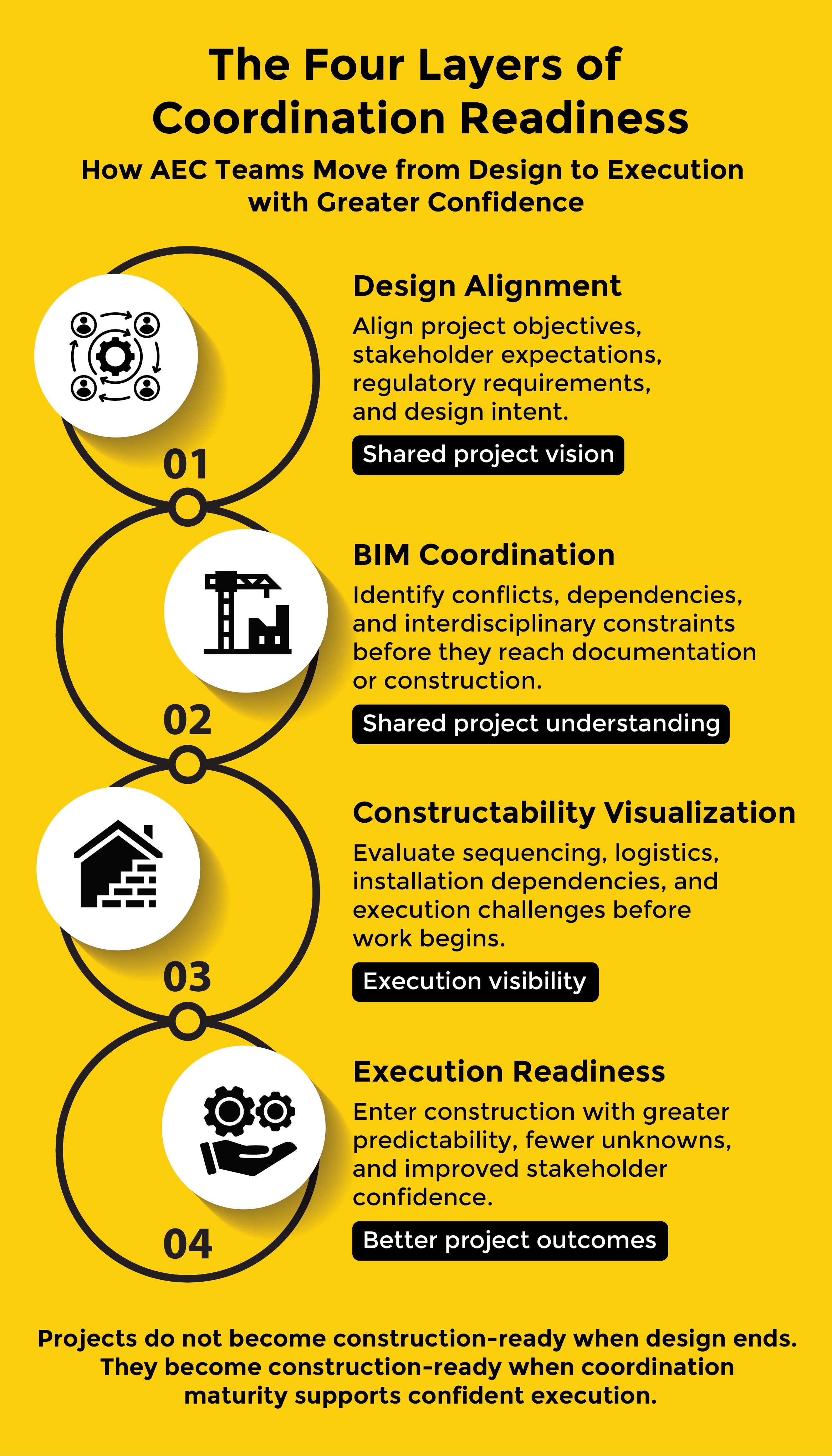
The Four Layers of Coordination Readiness
Definition: Coordination Readiness refers to the degree to which project information, design decisions, stakeholder requirements, documentation, and execution planning have been aligned to support confident construction execution.
Projects are often considered ready when drawings are complete, models are approved, and deliverables have been issued. Yet completion and readiness are not the same thing.
A project may contain all the required information while still carrying unresolved coordination risks beneath the surface. The more important question is not whether enough information exists, but whether that information functions together as a coordinated system.
One useful way to evaluate readiness is through four interconnected layers.
Layer 1: Design Alignment
Every project begins with intent.
Architectural, structural, operational, regulatory, and stakeholder requirements must align around a shared understanding of what the project is expected to achieve. Without that alignment, downstream coordination efforts often become exercises in resolving ambiguity that should have been addressed earlier.
Layer 2: BIM Coordination
Definition: BIM Coordination is the process of evaluating architectural, structural, and MEP models within a shared environment to identify conflicts, dependencies, and constructability challenges before construction begins.
Once project objectives are established, individual disciplines must be coordinated within a shared project environment.
This is where architectural, structural, and MEP models are evaluated collectively to identify conflicts, dependencies, and constructability concerns before they migrate into documentation or field activities.
Importantly, BIM coordination is not simply about clash detection. It is about creating confidence that independently developed design decisions can function together.
Layer 3: Constructability Visualization
A coordinated design is not automatically an executable design.
Project teams must understand how construction activities will unfold in practice. Sequencing requirements, access constraints, logistics considerations, installation dependencies, and project phasing all influence how effectively a project moves from design to delivery.
Constructability visualization transforms a coordinated design into a practical understanding of how work will actually be executed.
Layer 4: Execution Readiness
The final layer is confidence.
At this stage, stakeholders have sufficient visibility into design intent, discipline coordination, constructability implications, and documentation quality to make informed decisions with greater certainty.
The result is not simply a coordinated project.
It is a project that enters construction with greater predictability and fewer unanswered questions.
Why BIM Coordination Has Become a Strategic Discipline
If Design Alignment establishes project intent, BIM Coordination determines whether that intent can function across disciplines.
Historically, coordination was often viewed as a late-stage review activity. Teams compared drawings, identified discrepancies, resolved conflicts, and updated documentation before construction. While that approach remains necessary, modern project complexity has elevated coordination into something far more significant.
Projects rarely struggle because individual disciplines perform poorly. Research conducted by Autodesk and FMI found that miscommunication and poor project information account for nearly 48% of rework on construction projects, reinforcing the importance of early coordination and information alignment.
They struggle when independently developed decisions collide during execution.
This is where BIM Coordination creates value.
By evaluating architectural, structural, and MEP models collectively rather than in isolation, project teams gain visibility into relationships, dependencies, and constraints that might otherwise remain hidden.
Consider a duct route that conflicts with a structural beam. The clash itself is only the visible symptom. The underlying issue is that two valid design decisions evolved without sufficient awareness of one another.
BIM Coordination helps expose these relationships before they become construction issues.
Viewed this way, its purpose extends well beyond conflict detection.
It transforms isolated project knowledge into shared project understanding.
Within the Four Layers of Coordination Readiness, BIM Coordination forms the bridge between Design Alignment and Constructability Visualization. Without that bridge, design intent and execution planning remain disconnected.
BIM Coordination does not merely identify clashes. It reveals decisions that have not yet been made.
The most successful project teams understand this distinction. They use coordination not simply to find problems, but to build confidence that design intent, interdisciplinary requirements, and execution realities are moving toward the same outcome.
From Coordination to Constructability: The Role of VDC
Definition: VDC is a methodology that uses digital models and project data to evaluate sequencing, constructability, logistics, and execution strategies before physical construction starts.
While BIM Coordination helps teams understand how disciplines interact, Virtual Design and Construction (VDC) helps them understand how projects will be delivered.
A coordinated model can confirm that architectural, structural, and MEP systems fit together. Successful project delivery, however, depends on much more than physical compatibility. Teams must also understand sequencing, site logistics, installation constraints, trade interactions, resource dependencies, and construction workflows.
This is where Constructability Visualization becomes essential.
Rather than viewing a building as a collection of coordinated components, VDC encourages teams to view it as a future construction process. It enables stakeholders to visualize how work will unfold before work begins.
The question shifts from:
"Does the design work?"
to:
"Can the design be delivered efficiently, safely, and predictably?"
Through VDC-supported workflows, project teams can evaluate execution scenarios, anticipate constraints, and make informed decisions while there is still flexibility to respond. Every construction schedule is ultimately a sequence of dependencies. VDC helps project teams understand those dependencies before they become project constraints, making execution planning more proactive and less reactive.
A design may be perfectly coordinated from a modeling perspective yet still create sequencing challenges during construction. Likewise, installation access, trade dependencies, or site logistics can introduce risks that are not obvious from design documents alone.
VDC helps bring those realities into view.
BIM Coordination helps teams see the project. VDC helps them see the work required to deliver it.
Together, they strengthen the transition from coordinated design to execution readiness, reducing uncertainty and improving delivery confidence.
Why MEP Coordination Remains a Critical Test of Project Readiness
Among all coordination activities within an AEC project, few carry the same combination of complexity, interdependence, and execution risk as MEP coordination.
Mechanical, electrical, and plumbing systems must coexist within highly constrained spaces while accommodating structural requirements, architectural intent, equipment layouts, accessibility needs, safety considerations, and long-term maintenance requirements.
The challenge extends beyond geometry.
A duct may fit within a ceiling zone. A cable tray may avoid structural conflicts. A piping route may satisfy design requirements. Yet the project can still encounter execution difficulties if installation sequences, equipment clearances, maintenance access, or trade dependencies have not been adequately considered.
For this reason, MEP coordination often serves as a practical indicator of overall coordination maturity.
When MEP systems are coordinated effectively, project teams gain confidence that interdisciplinary decisions have been evaluated collectively rather than independently. When gaps remain unresolved, they frequently surface later as RFIs, field modifications, schedule disruptions, and avoidable rework.
Within the Coordination Readiness framework, MEP coordination sits at the intersection of BIM Coordination and Constructability Visualization. It requires teams not only to determine whether systems fit, but also whether they can be installed, operated, maintained, and managed throughout the building lifecycle.
The goal of MEP coordination is not merely to make systems fit. It is to ensure they can be installed, accessed, operated, and maintained as intended.
As project complexity grows, successful MEP coordination is becoming less about solving individual clashes and more about creating confidence in how the built environment will function long after construction is complete.
The Importance of Starting with Reliable Existing Conditions
The value of coordination is often discussed in the context of new construction. However, many renovation, retrofit, adaptive reuse, and facility upgrade projects face a different challenge: the project team may not be working from a completely reliable representation of existing conditions.
When drawings are outdated, documentation is incomplete, or previous modifications have not been accurately recorded, coordination risks can emerge before design work even begins. Teams may unknowingly make decisions based on assumptions rather than validated conditions.
In many retrofit and renovation projects, uncertainty about existing conditions becomes the first form of coordination debt. Teams can address design and construction challenges only after they have confidence in the physical reality they are working with. When that confidence is missing, assumptions often replace verified information.
This is where Scan-to-BIM plays an increasingly important role.
Definition: Scan-to-BIM is the process of converting laser-scanned existing-condition data into intelligent BIM models that support planning, design, renovation, retrofit, and facility-management activities.
By converting laser-scanned site data into accurate digital models, Scan-to-BIM helps establish a more reliable foundation for planning, design development, coordination, and documentation. Instead of attempting to reconcile discrepancies later in the project lifecycle, teams can begin with a clearer understanding of the physical environment they are working within.
The benefits extend beyond accuracy alone.
Reliable existing-condition models improve visibility into spatial constraints, structural elements, service routes, access requirements, and renovation limitations. This enables more informed decision-making while reducing the likelihood of unexpected discoveries during construction.
Within the Coordination Readiness framework, Scan-to-BIM strengthens the foundation on which all subsequent coordination depends. Put simply, the quality of project coordination can never exceed the quality of the information being coordinated.
The quality of project coordination can never exceed the quality of the information being coordinated.
For renovation and retrofit projects in particular, establishing that foundation early can significantly improve project predictability, reduce avoidable rework, and support more confident decision-making throughout the project lifecycle.
Coordination Is Proven Through Documentation and Performance
Coordination ultimately succeeds or fails through its ability to support project execution.
No matter how sophisticated a model may be, construction teams still rely on clear, accurate, and actionable project information to make decisions in the field. This is why construction documentation remains one of the most important outcomes of a mature coordination process.
Drawings, schedules, details, specifications, and documentation sets are often viewed as project deliverables. In reality, they are also indicators of coordination quality.
When architectural, structural, and MEP decisions have been effectively aligned, documentation becomes clearer, more consistent, and easier to execute. When coordination gaps remain unresolved, those gaps frequently appear later as RFIs, drawing revisions, field clarifications, and project delays.
Construction documents are not merely outputs of coordination. They are evidence of coordination quality.
The same principle increasingly applies to building performance.
As sustainability, operational efficiency, and lifecycle considerations gain importance, project teams are expected to evaluate not only whether a building can be constructed, but also how it is likely to perform. This has elevated the role of energy modeling within the broader project-planning process.
According to the U.S. Department of Energy, buildings account for approximately 40% of total U.S. energy consumption, increasing pressure on project teams to evaluate operational performance earlier in the design process.
Rather than functioning solely as a compliance exercise, energy modeling provides project teams with an opportunity to assess the potential performance implications of design decisions before construction begins. Factors such as building orientation, envelope characteristics, system selection, and operational efficiency can be evaluated earlier, enabling more informed decision-making.
Viewed together, construction documentation and energy modeling represent two important outcomes of coordination maturity. One helps ensure that projects can be executed more effectively. The other helps ensure that projects can perform more effectively.
Both reinforce a larger reality: successful projects are not defined only by how well they are designed, but by how well design decisions are translated into execution-ready and performance-oriented project outcomes.
What High-Performing AEC Teams Are Doing Differently
The AEC industry's approach to coordination is gradually evolving.
Historically, coordination was often viewed as a quality-control activity performed to identify and resolve conflicts before construction. Today, leading organizations are increasingly treating coordination as a strategic capability that influences project certainty, stakeholder confidence, and delivery performance throughout the project lifecycle.
This shift is being driven by the growing complexity of projects, tighter delivery schedules, higher client expectations, and an increasing focus on operational outcomes rather than construction outcomes alone.
As a result, high-performing AEC teams are moving beyond a reactive coordination model.
Instead of asking:
"What conflicts need to be fixed?"
they are increasingly asking:
"What decisions need to be understood?"
The distinction is significant.
Conflict resolution focuses on isolated issues. Coordination maturity focuses on relationships between decisions, systems, stakeholders, and project objectives.
The most successful organizations are therefore investing in greater visibility across design disciplines, stronger constructability planning, more reliable project data, and earlier stakeholder collaboration. In effect, they are working to reduce coordination debt before it accumulates.
In many respects, this represents the broader future of project delivery.
Competitive advantage is increasingly determined not by how efficiently projects are corrected during construction, but by how effectively they are coordinated before construction begins.
Building Coordination Readiness Across the Project Lifecycle
Achieving coordination readiness is rarely the result of a single activity, technology, or project milestone. It is the outcome of multiple capabilities working together to improve visibility, reduce uncertainty, and support better decision-making throughout the project lifecycle.
This is why leading AEC organizations increasingly view coordination as an integrated process rather than a collection of disconnected tasks.
Design teams need reliable BIM models to establish and maintain interdisciplinary alignment. Contractors require greater visibility into constructability, sequencing, and execution dependencies. Renovation and retrofit projects depend on accurate existing-condition data. Project stakeholders rely on clear documentation to move confidently from planning to execution. Increasingly, organizations must also evaluate how design decisions may influence long-term building performance.
These requirements are closely connected.
A coordinated project begins with reliable information, gains strength through collaborative design and model-based coordination, matures through constructability planning, and ultimately translates into documentation and project outcomes that stakeholders can trust.
This is the philosophy behind Vee Technologies' AEC services portfolio.
Through capabilities that include BIM Modeling, BIM Coordination, Virtual Design and Construction (VDC), MEP Coordination, Scan-to-BIM, Construction Documentation, and Energy Modeling, Vee supports project teams across multiple stages of the coordination journey, helping transform design intent into execution-ready project intelligence.
Rather than approaching these services as isolated deliverables, they are most effective when viewed as complementary components of a broader project-readiness strategy.
Because in today's increasingly complex built environment, successful project delivery depends on more than completing designs.
It depends on ensuring that design decisions, project information, stakeholder expectations, and execution realities are aligned long before construction begins.
Conclusion
In an increasingly complex AEC environment, successful project delivery depends on more than design quality or construction expertise alone. It depends on how effectively information, decisions, disciplines, and stakeholders are aligned before execution begins.
The projects that perform best are not necessarily those that encounter fewer challenges. They are often the ones that identify and address potential constraints while there is still time to act. From BIM Coordination and VDC to MEP Coordination, Scan-to-BIM, Construction Documentation, and Energy Modeling, every capability discussed in this article contributes to the same objective: reducing uncertainty before it becomes disruption.
Viewed through this lens, coordination is no longer a technical exercise or a final project checkpoint.
It is a measure of project readiness.
As projects grow more interconnected, competitive advantage may depend less on how efficiently teams respond to problems during construction and more on how effectively they prevent those problems through coordination before construction begins.
The real value of coordination readiness is not that it helps teams resolve issues earlier. It helps them make better decisions before those issues have the opportunity to exist.
In an industry where project complexity continues to increase, that distinction may become one of the most important competitive advantages an organization can build.
FAQs
What is BIM Coordination?
BIM Coordination is the process of evaluating architectural, structural, and MEP models within a shared project environment to identify conflicts, dependencies, and constructability issues before they impact documentation or construction activities.
How is BIM Coordination different from BIM Modeling?
BIM Modeling focuses on creating discipline-specific digital models, while BIM Coordination focuses on evaluating how those models interact with one another. Modeling creates project information; coordination ensures that information functions together effectively.
What is VDC in construction projects?
Virtual Design and Construction (VDC) is a project-planning approach that helps stakeholders visualize construction sequencing, logistics, installation requirements, and execution dependencies before work begins, improving constructability and delivery confidence.
Why is MEP Coordination important?
MEP Coordination helps ensure that mechanical, electrical, and plumbing systems can be installed, accessed, operated, and maintained without creating conflicts with architectural, structural, or operational requirements.
What is Scan-to-BIM used for?
Scan-to-BIM converts laser-scanned site data into accurate digital models that support renovation, retrofit, facility-management, and existing-condition projects where reliable site information is critical for effective planning and coordination.
How do construction documentation sets support project delivery?
Construction documentation sets translate coordinated project decisions into actionable drawings, schedules, specifications, and details that guide project execution, helping reduce ambiguity and improve field productivity.
How does energy modeling support project planning?
Energy modeling allows teams to evaluate the potential performance implications of design decisions before construction begins, supporting informed choices related to efficiency, sustainability, system selection, and long-term operational performance.