A Vee Technologies Perspective

Creating a Culture of Client-Centricity: The Practice of Curiosity

Prologue

Imagine a young executive walking into his first office in 1950s post-war America. The world of business around him is one of products, processes, and production. Success is measured by efficiency, scale, and output. Yet, while others devote themselves to perfecting what they make, he finds himself captivated by something else entirely - the people who buy it, the people who build it, and the changing needs that connect them.

Over the decades, he watches business philosophies evolve. With each new philosophy, he smiles quietly. The language has changed, but the questions have not. He never became particularly interested in becoming more client-centric. He simply remained curious about people.

prologue

As he prepares to retire, he leaves a note for the young leader who will take his place…

“You will inherit better technology than I did, more sophisticated processes than I could have imagined, and business philosophies that have yet to be written. Do not become too attached to any of them. They will change. People will not. If there is one thing worth learning over a lifetime of leadership, it is this: remain curious about people and their changing needs. Every meaningful business philosophy I have witnessed was simply another way of remembering that truth. If you learn to steward your people well and never stop learning alongside those you serve, the rest has a remarkable way of following.”

Executive Summary

Client-centricity is often described through customer satisfaction, responsiveness, and service excellence. While these outcomes are important, they do not fully explain what creates them. Research surrounding engagement, psychological safety, emotional intelligence, and organizational learning suggests that meaningful partnerships begin long before organizations interact with their clients. This paper explores the measurable human-centered practices that cultivate client-centric cultures and proposes that client-centricity is not something organizations achieve, but something they continuously learn through curiosity and understanding. Drawing on the experience of Vee Technologies, it also reflects on how these practices shape the way we serve our clients and the partnerships we build with them.

Introduction

Client-centered culture has become one of the business world’s most celebrated aspirations. Open almost any modern article on the topic and you’ll find familiar language surrounding customer satisfaction, responsiveness, communication practices, and service excellence. Yet, while these outcomes matter, they describe what clients experience rather than explaining what creates those experiences in the first place.

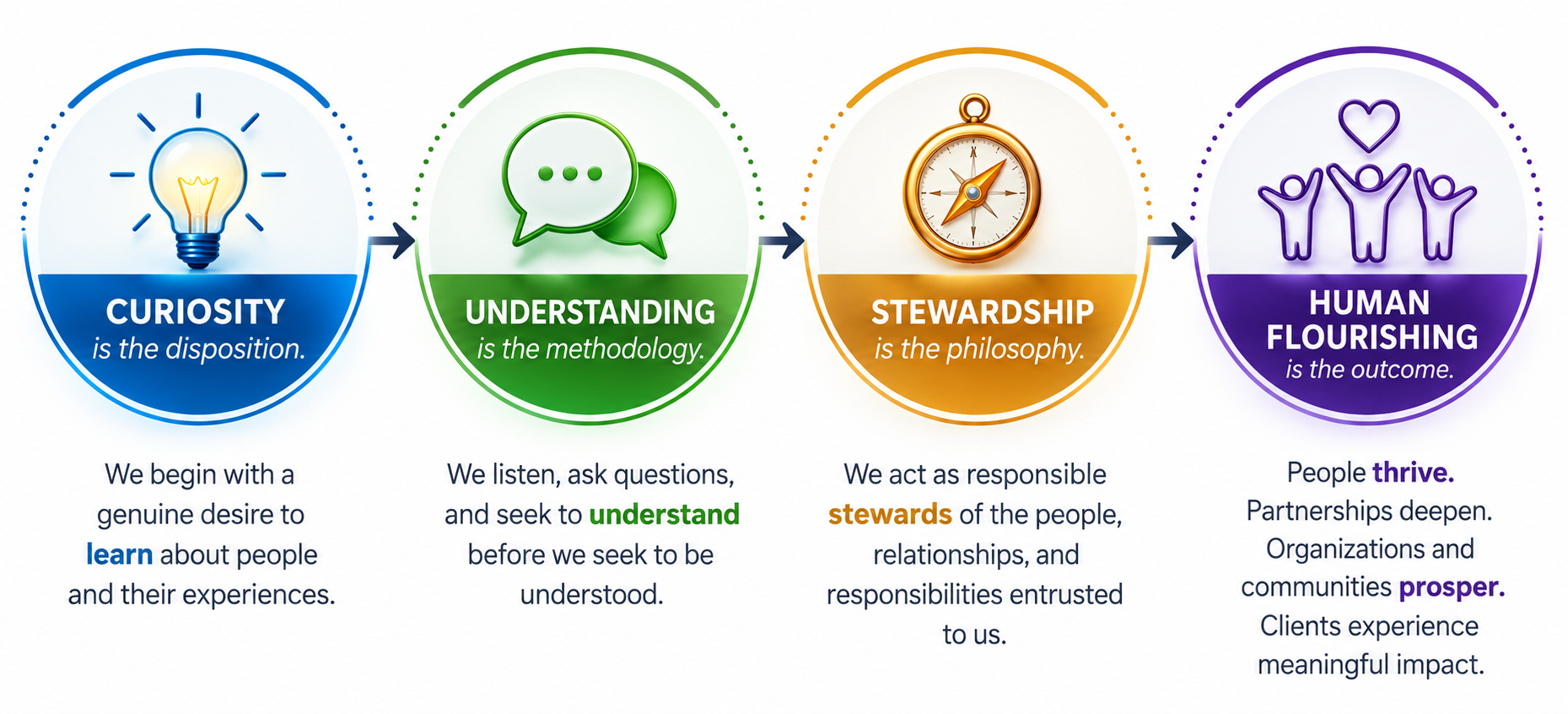
Client-centricity is not a framework, policy, or mission statement that can simply be put into place. It is the outcome of a shared mindset and set of values that govern how decisions are made, long before a client ever sees the result. In other words, client-centricity is an outcome, not the plan itself.

Perhaps becoming more client-centric is less about placing clients at the center of our business practices and more about intentionally cultivating cultures of curiosity, understanding, and continuous learning. After all, clients don’t experience our mission statements, organizational charts, or company policies. They experience our people.

At Vee Technologies, this idea is not new. Our story began with a family that believed learning could change lives. Now in our fourth generation of family ownership, we continue to hold education, ethics, and responsibility as the foundation of how we work. Our mission, to globalize success to make lives better, is a daily reminder that extraordinary outcomes for our clients begin with the people who deliver them.

“Clients don’t experience our mission statements, organizational charts, or company policies. They experience our people.”
Curiosity, Understanding, Stewardship, and Human Flourishing

The Big Three: Engagement, Psychological Safety, and Learning Culture

Warren Berger, author of the award-winning book A More Beautiful Question, posits that meaningful change begins when individuals and organizations stop asking questions merely to gather information and instead challenge assumptions, remain curious, and pursue better understanding through continual inquiry (Berger). Rather than asking, “How can we become more client-centric?” perhaps we should ask a different question: What are the measurable practices of organizations that cultivate human-centered cultures?

Research from Gallup, Google, and other thought leaders consistently points to three key human-centered factors:

  • Engagement
  • Psychological Safety
  • Culture of Continual Learning

Though distinct, these factors are deeply interconnected and collectively shape both employee and client experiences. Organizations create better outcomes when they intentionally create environments in which people can flourish together.

Engagement: Client-Centricity Begins Before We Ever Meet Our Clients

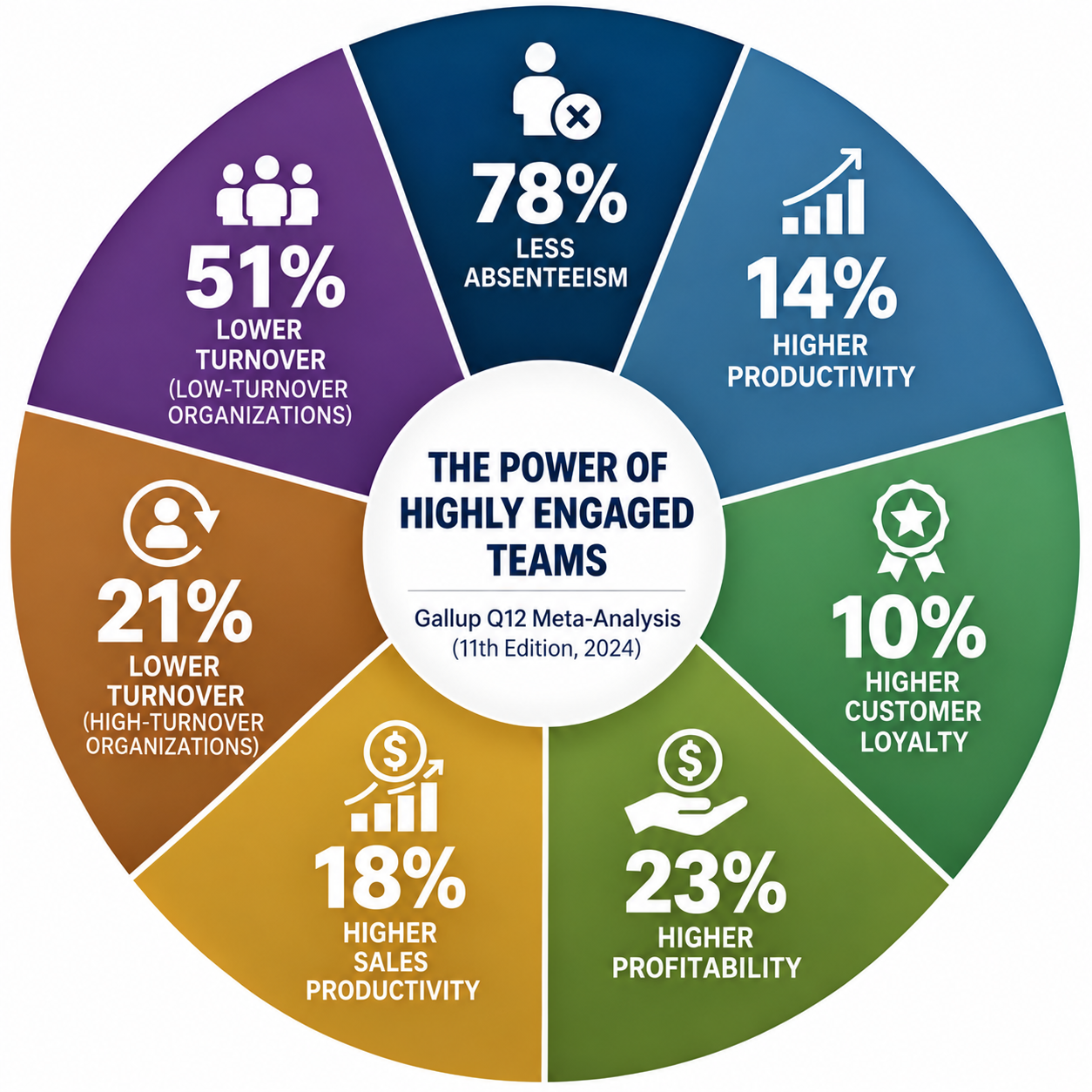
The Gallup research team, led by Jim Harter, analyzed over 183,000 business units around the globe across 53 industries to better understand the impact of employee engagement on business success. Higher employee engagement consistently produced better outcomes. Companies ranking higher in engagement experienced 14% increased productivity, 10% higher customer loyalty, 18% greater sales productivity, 78% less absenteeism, and an overall 23% improvement in profitability compared to companies with low employee engagement (Harter).

Gallup also found that these outcomes are directly linked to the individual employee experience. As the research team notes, “Company culture comes to life through the employee experience” (Harter). In other words, engagement does not stay inside the organization: the more engaged the employee, the more engaged the customer.

the-power-of-highly-engaged-teams

People who are seen, empowered, listened to, and who feel valued don’t just engage more; they become the conduit through which a company’s commitment to client-centeredness is realized. Our written policies and guidelines may describe that commitment, but it is our people who carry it to the customer.

At Vee Technologies, we have seen this firsthand. Our certification as a Great Place to Work®, a distinction based entirely on employee feedback, reflects a simple belief: when we invest in our people, our clients feel it. The engineers, designers, developers, and specialists who support our customers each day are not simply delivering a service. They are extending our culture into every partnership.

“When we invest in our people, our clients feel it.”

Psychological Safety: Giving Curiosity a Voice

Google’s Project Aristotle sought to understand what makes highly effective teams successful. At the heart of their findings was the concept of psychological safety, developed by Harvard Business School professor Amy Edmondson.

Psychological Safety – the shared belief that individuals can voice ideas, ask questions, or admit mistakes without fear of humiliation, punishment, or retaliation (Edmondson).
psychological-safety

Google’s findings identified five dynamics shared by its most effective teams: psychological safety, dependability, structure and clarity, meaning, and impact. Of these, psychological safety mattered most, serving as the foundation that made the other four possible (Google). Most notably, talent alone did not determine team success. Success was more closely connected to how team members interacted with one another and embodied the principles of psychological safety (Google). Curiosity, it seems, needs safety before it can find its voice.

We believe the same principle extends beyond our internal teams to the partnerships we share with our customers. At Vee Technologies, we strive to create an environment where curiosity is welcomed, voices are heard, and accountability is shared rather than imposed. That same spirit guides our customer governance reviews, where we ask questions such as, “How would you like to see our relationship grow?” and “What would you change?” Through our annual quality survey, we invite candid feedback so we can better understand our strengths and where we can improve. This process and feedback are not formalities. They are how we continue learning alongside those we serve.

Learning Culture: Curiosity in Practice

Psychological safety naturally creates the conditions for continual learning. When people feel safe to ask questions, challenge assumptions, and explore new ideas, curiosity flourishes. Organizations that intentionally cultivate these environments become better students of the people they serve.

Daniel Goleman’s work on emotional intelligence (EQ) suggests that business success is influenced not only by academic intelligence (IQ), but also by our capacity for self-awareness, self-regulation, empathy, social skills, and motivation (Goleman). These competencies shape how we communicate, collaborate, adapt, and ultimately understand one another, including the clients we serve. Empathy, in particular, is what allows us to notice a client’s changing needs before they are spoken. Alongside technical expertise, organizations should begin to recognize EQ as an organizational competency rather than dismissing feelings as something that gets in the way of progress.

learning-culture

Learning cultures are not built solely upon what people know, but upon their willingness to remain curious enough to learn what they do not yet understand. Organizations best equipped to cultivate meaningful partnerships never stop learning from their people and their changing needs.

For Vee Technologies, continual learning is part of our foundation. Our core strengths of Accuracy, Competency, and Teamwork are sustained by a long-standing commitment to education, supported by our own Sona College, where talent development can evolve alongside the changing demands of our clients and industries. Our quality policy calls for continual improvement in our services, processes, and people to meet the ever-changing needs of our clients. In practice, this means our team remain students of the work and of the people we serve.

Conclusion: The Work of Understanding Never Ends

The work of understanding never ends because the people, relationships, and needs at the heart of every organization continue to evolve. Client-centricity therefore depends on more than a well-designed initiative; it depends on whether curiosity, understanding, and human success consistently shape the way an organization listens, learns, and makes decisions.

Like the seasoned executive in our prologue, reflecting on his journey before passing on his legacy, each of us leaves a mark on our organizations and on what we pass to the next generation. Meaningful partnerships are cultivated when organizations remain curious enough to steward the people, relationships, and responsibilities entrusted to them.

At Vee Technologies, this is the legacy we strive to carry forward. Across our team, we remain committed to globalizing success to make lives better by caring for our employees, listening closely to our clients, and continuing to learn alongside both. We believe that is how lasting partnerships, and extraordinary outcomes, are built.

Perhaps the most client-centric organizations are not those that simply place their clients at the center of their business practices, but those that intentionally cultivate environments in which people continually learn how to better understand one another. Clients may never see our mission statements, organizational charts, or internal processes, but they experience the people who represent us every day. How we lead our people ultimately becomes how we serve our clients.

Sources

  • Berger, Warren. The Book of Beautiful Questions: The Powerful Questions That Will Help You Decide, Create, Connect, and Lead. Bloomsbury Publishing, 2018.
  • Edmondson, Amy C. “Managing the Risk of Learning: Psychological Safety in Work Teams.” Harvard Business School Working Paper, no. 02-062, 2002.
  • Goleman, Daniel. Emotional Intelligence: Why It Can Matter More Than IQ. Bantam Books, 1995.
  • Google re:Work. “Understand Team Effectiveness.” Google, rework.withgoogle.com/intl/en/guides/understand-team-effectiveness/. Accessed 22 July 2026.
  • Harter, Jim, et al. Q12 Meta-Analysis: 11th Edition. Gallup, 2024, www.gallup.com/workplace/321725/gallup-q12-meta-analysis-report.aspx. Accessed 22 July 2026.
Jessie-Zollinger

Meet the Author

Jessie Zollinger - Client Operations Director

Jessie Zollinger leads with courage, creativity, and a commitment to authentic connections at Vee Technologies. With over 10 years of experience managing people and processes, she is a skilled team facilitator, software engineer, and operations professional. Jessie believes that empathy, trust, and meaningful conversations are at the heart of great work. This approach translates into measurable value for Vee Technologies' clients, resulting in more effective solutions, streamlined processes, and stronger partnerships that drive long-term success.

Ready To Start?

Connect with our experts for tailored solutions to your most urgent business challenges.

Get in Touch

Looking For a Job?

Ready to grow your career? Join a global team that values innovation, impact, and individual growth.

View Open Role