We share insights, analysis and research – tailored to your unique interests – and make case studies and whitepapers to help you deepen your knowledge and impact.
In this white paper, Reid Wissler, Senior Design Engineer, discusses how considering the voiceless stakeholder in product design can lead to more sustainable practices and reduce environmental impact.
Please click on the video to the right to learn more about the author, hear his insights on this white paper, and discover what motivated him to write about this topic.
To discuss this white paper in detail, please contact Reid using the information provided at the bottom of the page.
The urgent and escalating issue of plastic waste in our oceans demands immediate and effective action from both businesses and consumers. This necessitates strategic interventions at various levels, including stakeholder governance within companies and conscientious raw material selection during the product design phase.
Generally speaking, a company’s governance falls into two primary different models: shareholder or stakeholder models. There has been an increasing emphasis on a stakeholder model. They each approach a company’s governance very differently. A shareholder model places a higher priority on the interest of the shareholders and the financial return on their investment. A stakeholder model, however, takes a broader view and accounts for how a business’ activities impact multiple groups or entities. Under a stakeholder model, the company’s stakeholders are defined and make the company's direction; the day-to-day operations decision-making is considered when establishing the company's direction, day-to-day operations decision-making, and during the product development planning.
A stakeholder model company generally considers its stakeholders as a person, group, or entity positively or negatively affected by a policy it implements or the products it produces. The stakeholders could be internal or external to the organization. Company stakeholders are the investors looking for a return on their financial investment, the employees looking for gainful employment, the customers looking to buy goods and services, the suppliers providing their goods or services to the company, and even our communities and government.
Regrettably, in many instances of decision-making within a company’s governance, the environment, particularly our oceans, is the least considered stakeholder when products and packaging are being designed. This is especially true for products and packaging made from plastics. Our oceans, which serve as both a supplier and a customer in the stakeholder classifications, provide us with raw materials (crude oil and natural gas) to make plastics. However, marine life and the ocean’s ecosystems, the unfortunate recipients of the plastic and microplastic waste we generate, bear the brunt of our design decisions.
The amount of plastic waste entering our oceans each year is shocking. Between 12 and 14 million tons of plastic end up in the oceans annually, equivalent to dumping a garbage truck's worth of plastic every minute. According to Statista, an independent global data and business intelligence platform, global plastic production has soared in the 50 years since it became commercially produced. The U.S. significantly contributes to growing problems as we are one of the world’s largest consumers. We have tripled our use since the 1980s.

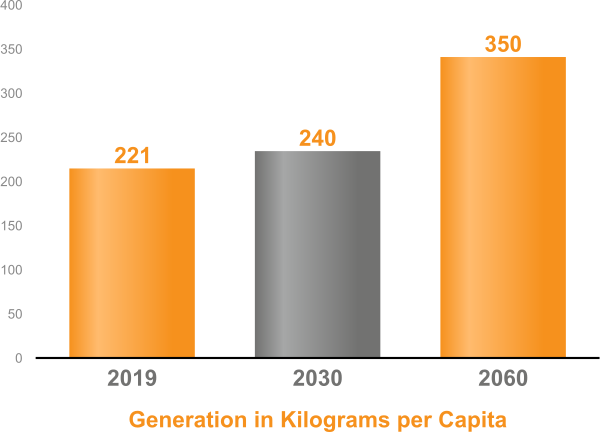
In 2019, U.S. plastic waste generation was estimated at 80.5 million tons, corresponding to more than 485 pounds per person annually. This was roughly five times more than the average person generates globally. With plastics demand showing little signs of slowing down, U.S. plastic waste generation is projected to surpass 154 million tons by 2060. Currently, plastics account for roughly 12% of U.S. municipal solid waste generation, with plastic containers and packaging being one of the leading sources.
The pace of our country's recycling programs has not kept pace with the U.S. municipal plastic waste generation increasing five-fold since 1980. The U.S. exports large volumes of plastic waste yearly to countries worldwide, with Canada and Mexico being the main destinations. China has restricted much of its foreign waste imports, with many other Asian countries doing the same. This has strained the already struggling U.S. recycling system, causing more plastic waste to be dumped into our oceans. Once in the sea, plastics persist for hundreds to thousands of years, slowly breaking down into smaller fragments known as microplastics.
Microplastics are everywhere in marine environments, contaminating water and ecosystems from the surface to the deep sea. The microplastics are suspended throughout the ocean’s depths, making cleaning up extremely difficult and impossible after the waste reaches our oceans. Large concentrations of plastic debris also accumulate in gyres, where ocean currents converge, forming vast waste patches like the Great Pacific Garbage Patch. Plastic pollution poses the greatest threat to the ocean’s marine life as they often mistake plastic debris for food, leading to ingestion and entanglement, resulting in internal injuries, digestive blockages, and starvation, ultimately leading to death.
Marine ecosystems such as coral reefs, mangroves, and seagrass beds are also disrupted, which provide vital habitats, food, shelter, and breeding grounds for aquatic life. Seafood contaminated with plastic particles and toxins ultimately enters the human food chain as well, potentially causing harm to consumers.
The most efficient way to combat a problem is to identify its origin through a root cause analysis. Many times, the origin of any social responsibility problem is the company’s governance model. As previously described, a stakeholder governance model prioritizes all entities by how they are impacted by the company’s day-to-day activities and the products it produces. It establishes the framework for ensuring that all stakeholders share an equal voice on how they are positively or negatively impacted, offering a hopeful path forward.
If a non-biased stakeholder impact analysis is performed before any new product development, it will help identify those stakeholders negatively impacted by the product it produces. Mitigating the negative impacts on any one stakeholder is paramount. It should be met with the same tenacity and grit as ensuring the new product provides a positive return for any investor’s financial investment. The necessity of this step cannot be overstated, as it is a key to preventing further harm.
At the origin of any consumer product design cycle is raw material selection. The selected raw material must withstand the environmental and physical elements the product will be exposed to during its lifecycle. Far too many plastic consumer products and their packaging cannot be recycled because of poor selection of raw materials during the design phase. Consumer items such as Ziplock bags, inner bags for cereal boxes, bubble wrap, plastic food wrap, packing peanuts, clothing hangers, plastic eating utensils, and candy bar wrappers, to name a few, are all examples of single-use items made from plastic, that are unable to be recycled. Non-recyclable and non-biodegradable plastics are chosen primarily with only the shareholder considered, with corporate profits driving investor returns and end consumer convenience as the primary considerations.
The best approach is to select alternative raw materials that are biodegradable, renewable, and recyclable, such as bamboo, glass, metal, beeswax paper, plant-based food bags, etc. The initial cost for the raw material may be higher, but the aggregate long-term cost would likely be lower. Suppose tax credits were offered to consumer products corporations, incentivizing them to design recyclable plastics and biodegradable materials into their products and packaging. In that case, it would likely help offset the added cost of material. The result would likely help offset any added cost to the end consumer, pushing the consumer away.
Much has been written and advertised about advancements in recycling practices and capabilities. Progress is also being made in legislation restricting single-use non-recyclable plastics. Prevention through recycling promises to manage this ever-increasing problem. Many programs have been implemented and imposed on the consumer within the recycling sphere to combat this increasing problem. Indeed, recycling is a crucial component to mitigating this problem.
However, I contend that prevention during corporate governance and the product design stage can provide a far more significant benefit by cutting off the supply at the source during the design and product development stages rather than trying to deal with plastic waste.
Because we are a consumer and convenience-driven society, consumers will gravitate to whatever is most readily available, most convenient, and competitively priced.
By instituting corporate governance best practices, driving responsible raw material selection during the product design stages, along with tax credit incentives offered at our local, state, and federal government levels, the amount of plastic waste entering our landfills and, more importantly, our oceans, could be significantly reduced at the source rather than after it has already become waste.
PEW Research Center
https://www.pewtrusts.org/en/projects/preventing-ocean-plastics
Statista
https://www.statista.com/topics/5127/plastic-waste-in-the-united-states/#statisticChapter
Recycle Track Systems (RTS)
https://www.rts.com/blog/plastic-pollution-in-the-ocean-facts-and-statistics/#:~:text=There%20is%20an%20estimated%2075,waste%20management%20and%20recycling%20infrastructure.
Reid Wissler brings over 37 years of expertise in product development, manufacturing engineering, and project management. Since joining Vee Technologies in 2023, he has focused on engineering innovation, leading product development for aerial ladders and work platforms, and improving manufacturing processes. With a deep understanding of hydraulic systems and strategic product management, Reid is instrumental in driving efficiency and productivity for clients. His vast industry experience positions him as a key leader in Vee Technologies' engineering services.
Connect with our experts for tailored solutions to your most urgent business challenges.
Get in TouchReady to grow your career? Join a global team that values innovation, impact, and individual growth.
View Open Role